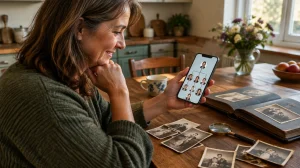
Almost every family has a story that repeats itself at Sunday lunch: the great-grandfather who arrived by ship, the great-great-grandmother who was a farmer's daughter, the surname that "was spelled differently before." Building a family tree is the work of separating memories from documents—and the good news is that most Brazilian documents are already digitized and free.
This guide shows the right order to start, what to ask for in each place, public collections that don't charge anything, and the pitfalls that cause serious people to attach the wrong branch to their own tree.
Start with what is alive.
The primary source isn't any website: it's the oldest relatives. They keep names, nicknames, approximate dates, and—most valuable—the... places. Without the city, documentary research is blind, because old records are organized by parish and registry office, not by surname.
Bring a short script and record the conversation with permission:
- Full name of each grandfather and great-grandfather, including the maiden name of the women.
- City and state of birth, marriage, and death of each individual.
- Profession and religion — both appear in old records and help to confirm identity.
- How many siblings did each one have? Siblings are the key to confirming a couple when the names are the same.
- If someone came from abroad: country, approximate year of arrival, and port of arrival.
Next, rummage through your drawer at home.
Old birth certificates, work permit, voter registration card, photograph with a note on the back, wedding invitation, memorial card from a seventh-day mass, vaccination record, land deed. Each of these documents has the full name, date, and place—exactly the trio that the research requires. Photograph everything before returning it to the box.
Full-text certificates
There is a difference that changes the search: the certificate in brief account It brings the essentials, while the one of full text It reproduces the complete record, with the names of the parents, grandparents, witnesses, professions, and marginal notes. That's the one you want.
The request can be made at the registry office where the act was registered or through the Civil Registry portal, without leaving home, paying the certificate fee. Each new certificate usually reveals two previous generations — it's the snowball effect that makes the tree grow.
The free collections that solve most of the problem.
FamilySearch
It is the largest free genealogical collection in the world, maintained without subscription fees. For Brazil, it has digitized civil records in cooperation with the National Archives and holds baptism, marriage, and death records from numerous parishes. It requires free registration and has its own app for consulting and building the family tree via mobile phone.
National Archives
The National Archives' consultation system brings together lists of immigrants who entered through the port of Rio de Janeiro, marriage license applications, inventories, and historical collections. One of the most useful databases for those with Portuguese roots is the one on the movement of Portuguese people in Brazil at the beginning of the 19th century, with tens of thousands of records that include age, marital status, profession, origin, and destination.
Immigration Museum, in São Paulo
Here is the treasure of those who have Italian, Japanese, German, Spanish, Portuguese, or Arab ancestors who disembarked in Santos. passenger lists The records of ships, from 1888 onwards, are digitized and available for free consultation and download, in a collection with hundreds of thousands of images. Each line shows the passenger's name, age, marital status, profession, nationality, origin, and destination — and it is there that the original spelling of the surname usually appears, before the Brazilian registry office adapted it.
Parishes
Before 1889, there was no civil registry in Brazil: births, marriages, and deaths were recorded by the Church. To navigate through the 19th century, the key is the baptismal register of the local parish—some are already on FamilySearch, and the rest are usually consulted at the diocesan curia itself.
How to organize without losing track.
- One person, one record. Full name, dates and places of birth, marriage and death, with the source noted in each field.
- Source always. “Marriage certificate, registry office such-and-such, book 12, page 30” is worth more than any certainty of memory.
- Mark what is an estimate. “"Born around 1890" is useful information, as long as it's made clear that it's an approximation.
- Export to GEDCOM. It's the universal genealogy format and allows you to transfer your tree from one application to another without having to type everything again.
- Save the images. Download the document, not just the link: the archive changes address, but the file on your computer doesn't.
The apps: what each one solves
The FamilySearch app builds the tree and searches free archives, and is the best starting point. MyHeritage and Ancestry build the tree and suggest automatic matches in records from various countries, but more complete searches require a subscription. There are also simple apps that only draw and save the tree on the device, useful for those who want to organize before searching. There is an annotated list of them in the guide. apps for building a family tree.
A word about "automatic matches": they are suggestions calculated based on name and date similarity, not confirmations. Accepting without checking the document is the quickest way to import someone else's error into your own history.
The traps that catch almost everyone.
- Namesake. In a small town in the 19th century, there were three José Maria da Silvas in the same parish. Confirm by the names of the parents and spouse, never just by the name and year.
- Variable spelling. Souza and Sousa, Luiz and Luís, Sylva and Silva, Ferrari and Ferrare. Search for all forms, including those that seem wrong.
- Ready-made tree from the internet. Many were copied from each other without any documentation. Use them only as a clue to be verified.
- Dates of declared age. “"Was 40 years old" on a death certificate is usually a guess by the person making the declaration.
- The name adapted to Portuguese. The immigrant's recorded information, obtained by ear, became something else entirely on paper. First, check the passenger list, which preserves the original record.
And what about the DNA test?
He answers another question. The ancestry test estimates which regions of the world your ancestors likely lived in and can connect you to other people who have also taken the test, but it doesn't return names, dates, or documents—and that's precisely what a family tree is made of. Before sending a sample, read what the company does with the material and the genetic profile, because genetic data is sensitive information and consent is usually valid indefinitely.
Common questions
How far can we go?
In Brazil, those with colonial roots often trace their history back to the 1700s through parish records. Families who arrived through immigration typically encounter their country of origin, where research continues in European, Japanese, or Arab archives.
Do I need to pay a notary fee for each certificate?
Yes, there is a fee for the certificate. But a lot of information is already digitized and free in public archives — it's worth checking there before requesting it.
How do I read a 19th-century manuscript?
With patience and comparison: copy familiar words from the same scribe and use them as a reference alphabet. FamilySearch maintains free paleography material for this purpose.
Is it possible to decorate the tree using only a cell phone?
Yes, the FamilySearch app lets you search, attach documents, and build the entire tree from your device—just make sure to save the images you download in a safe place.
In summary
Talk to older people before opening any website, gather documents from home, request full-text birth certificates, and use free resources in this order: FamilySearch, National Archives, Immigration Museum, and lastly, the parish. Note the source of each piece of information. The family tree that survives is not the oldest: it's the one with documentation under each name.