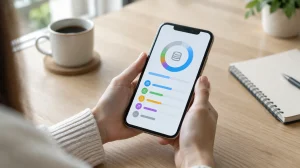
Digitizing documents is an increasingly common need in our routine. Storing documents in digital format brings many advantages, such as accessibility and security. However, it is not always possible or practical to use a computer to perform this scanning. That's where apps for scanning documents on your cell phone come in.
These applications are a simple and efficient solution for those who need to digitize documents and want to avoid paper disorganization at home or in the office.
With so many options available, choosing the best app can be a challenge. But don't worry, in this article, we'll introduce you to the best apps for scanning documents on your cell phone.
The 5 best apps for scanning documents on your cell phone
Discover the best apps for scanning your documents on your cell phone and choose the one that best meets your needs. Remembering that each application has different functionalities and resources, so pay attention to our list below:
1. Adobe Scan
Adobe Scan is one of the best options for scanning documents on your cell phone. It offers automatic text recognition, turning your photos into editable PDF files.
With an intuitive interface, you can also scan documents and automatically save them to the cloud for later access. Additionally, Adobe Scan also allows you to adjust the image and correct distortions to ensure a high-quality scan.
2. CamScanner
CamScanner is another popular app for scanning documents on your cell phone. It allows you to adjust the image, correct distortions and even add notes to scanned documents.
CamScanner also allows you to share files with other users through links or social networks. Furthermore, the application has a large number of resources and the possibility of cloud storage. Therefore, CamScanner is a solid choice for scanning documents.
3. Microsoft Office Lens
Microsoft Office Lens is an option for scanning documents with additional features. This is because, with it, it is possible to obtain automatic text recognition and image adjustment.
It also lets you save documents to OneNote, OneDrive, or send via email.
Microsoft Office Lens is a viable choice for those who already use Microsoft's productivity suite and are looking for a document scanning option with extra features.
4. Google Drive
Google Drive is also a simple solution for scanning documents on your cell phone, with the possibility of storing scanned documents in the cloud. It allows you to scan documents with a cell phone camera and save directly to your Google Drive account.
Additionally, Google Drive also offers basic image editing features such as distortion correction and brightness adjustment.
5. Evernote Scannable
Evernote Scannable is an easy-to-use option for scanning documents on your cell phone, with the ability to save scanned documents in Evernote. It offers automatic text recognition, image adjustment and even the ability to save documents as notes in image format.
With an intuitive interface, Evernote Scannable is also a good option for those looking for a simple and efficient solution for scanning documents.
Veja também:
- Learn to drive on your cell phone – Discover the apps!
- Learn to drive on your cell phone – Discover the apps!
- Cell phone tracking apps: How to Download and Use
Conclusion
Nowadays, it is increasingly important to have access to tools that enable document scanning in an efficient and practical way. When evaluating the available applications, we noticed that there are options that meet different needs, from users looking for a simple and quick solution to those who need more advanced features.
Regardless of your choice, the important thing is that you can scan your documents quickly and easily, without having to leave your home or go to a copy store. Choose the application that best meets your needs and start scanning your documents with ease and convenience.
What to look for before installing
- Update frequency. An app that hasn't been updated in over a year is likely to break with the next system version.
- It works offline. Many of these utilities don't require internet access. If an app requires a connection for a local task, you should be suspicious.
- Size and memory usage. Utility applications should be lightweight. Those that exceed a few hundred megabytes often contain advertisements and trackers.
- Permissions that the application requests. It's the quickest test of reliability. A flashlight app that asks for contacts and location doesn't need that to work.
What these apps don't do
Before installing, it's worth managing your expectations: there are things that no app in this category delivers.
- Features that rely on missing hardware won't work via software. Without the sensor, no application can solve the problem.
- Apps that promise impossible functions are often advertising platforms, and some request permissions they shouldn't.
- They are not a substitute for professional equipment. Cell phone sensors are for estimation, not for technically precise measurements.
- Cleaning apps don't permanently speed up your device: Android already manages memory on its own.
Common questions
Do I have to pay to use it?
In most utilities, no. The free version with ads works fine, and the paid version is for removing ads.
How do I know if an app is trustworthy?
Look at the developer, number of reviews, date of last update, and permissions requested. Those four together say a lot.
Does it consume a lot of battery?
It depends on what's running in the background. Check the usage per app in the settings and restrict anything that's excessive.
Does it work without internet?
Those that process locally, yes. Those that rely on a server require a connection and send their data externally.
Are these apps safe?
Check the permissions and the number of reviews. Any utility that requests access to contacts, messages, or accessibility without a clear reason should be avoided.
Step-by-step to get started
- Restart before concluding that it's slow. Much of the slowness disappears with a restart, without needing any application.
- See what takes up space before installing a cleaner. In Settings › Storage, the system itself shows the breakdown by type. Almost always the culprits are video and social media cache.
- Clear the cache of larger applications. You can do it app by app in the settings, without installing anything, and without losing your login or settings.
- Uninstall anything that hasn't opened in months. The list by usage time is in the settings. It's the most lasting way to save space.
Traps that catch almost everyone
- Deleting an application folder through the file manager can result in lost data that cannot be recovered.
- Trusting an app that promises functionality without having the corresponding sensor on the device.
- Install three utilities that do the same thing, all running in the background.
- Installing a cleaner that promises to speed up your phone — Android already manages memory on its own, and the gains don't last.
The alternative that is already included in the system
Android and iPhone already include features like a flashlight, voice recorder, document scanning, QR code reader, ruler, compass, level, and screen recording. Before installing, it's worth checking the settings – many people install what they already have.
Is a scanned copy legally valid?
This is a question that always comes up and has a straightforward answer in Brazil. Law 13.874/2019, the so-called Economic Freedom Law, established that a digitized document, provided that the digitization is done using a technique that guarantees its integrity, produces the same legal effects as the original. Decree 10.278/2020 detailed the technical requirements.
What the standard requires, broadly speaking:
- Digital signature with a certificate in accordance with the ICP-Brasil standard, or using another means of proving authorship and integrity accepted by the parties.
- Required metadata, such as the date and time of scanning, identification of the person responsible and the device.
- Proper resolution and format to the preservation of information.
In other words: a photo of a document taken with a cell phone and saved as a PDF is not equivalent to the original for all purposes. It serves perfectly well for informal sending, for verification, for the company's HR department that requested a copy, or as proof that you received something. However, to replace the original in a formal process, a procedure with a digital signature is required.
It's worth knowing about two free tools: the electronic signature available on the gov.br platform, which allows you to sign PDFs with validity recognized by public bodies, and the ICP-Brasil certificate, which is paid and required in more formal situations. Both solve most of the needs of those who digitize documents at home.
Resolution, format, and file size.
Scanning too high generates a huge file with no gain; scanning too low makes the text illegible and renders character recognition useless. Practical references:
- 200 dpi: Minimum minimum for large texts. Suitable for quick proofreading.
- 300 dpi: The standard for documents containing text. It's the resolution at which optical recognition works well and the printout is legible.
- 400 to 600 dpi: necessary for small print, blueprints, maps and historical documents.
- Above all: It only makes sense for the preservation of collections.
Regarding color mode: plain text documents appear smaller and more legible in black and white or grayscale; documents with stamps, colored signatures, photos, or seals require color, because in many cases color is an element of authenticity. When in doubt with an official document, scan it in color.
Regarding format: PDF is the standard for multi-page documents and preserves order and integrity. There is also PDF/A, a variant designed for long-term archiving, which embeds fonts and avoids external dependencies. JPEG is suitable for single-page and informal use, but each save recompresses the image.
Size reference: an A4 page of text at 300 dpi, in grayscale and well compressed, is usually between 100 and 300 KB. If your scanned page is 8 MB, the configuration is oversized — and many file submission systems have size limits.
OCR: transforming images into real text.
Optical character recognition (OCR) is the feature that distinguishes an image file from a useful document. Without it, a PDF is just a photograph: you can't search for words, copy passages, or select anything.
What changes when OCR is applied?
- Keyword search within the file and, depending on the system, in the phone's own search function.
- Copy of excerpts without retyping.
- Accessibility. Screen readers can read the content, which is not possible with a pure image.
- Automatic organization by content, instead of by filename.
What hinders recognition: handwritten text, decorative font, crooked document, shadows, low resolution, crumpled paper, and text on a colored or stamped background. Although modern OCR correctly identifies most printed text, it makes mistakes with numbers—and a single incorrect digit in a value or a CPF (Brazilian taxpayer ID) number creates a real problem. Important documents always require verification of the recognized text.
It's worth knowing that both Android and iPhone already recognize text in images within the camera and gallery apps, without needing to install anything. This solves the problem of quickly copying information from a piece of paper.
The five-point capture technique
Poor scanning is almost never the app's fault. It's usually due to lighting and positioning.
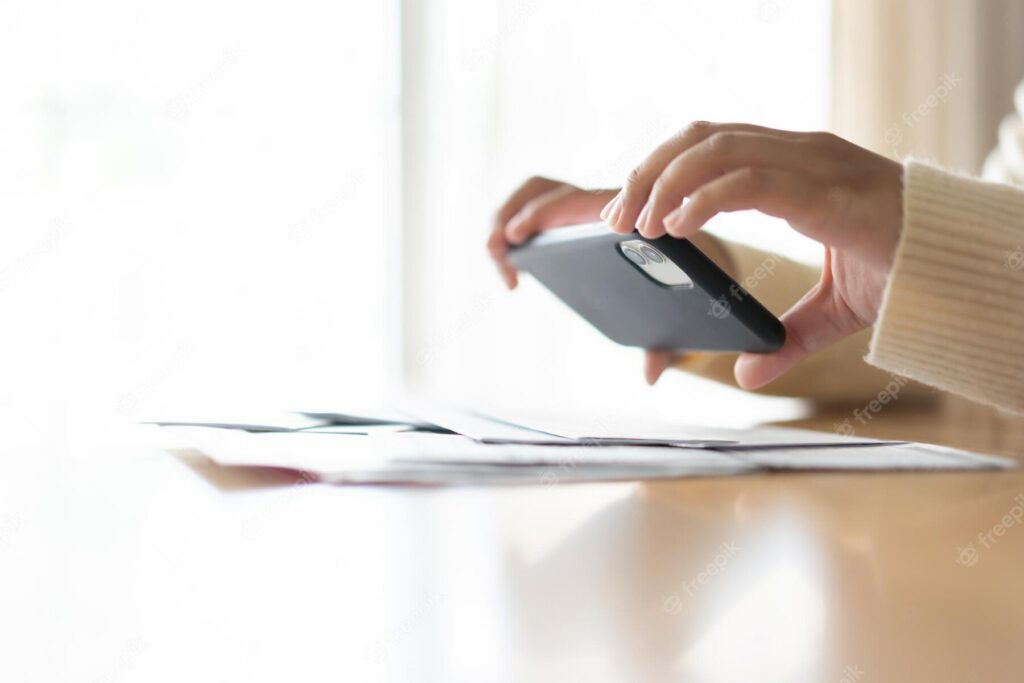
- Flat, contrasting surface. White paper on a dark table allows the application to automatically detect the edges. On a white table, the detection fails.
- Diffuse and uniform light. Never use flash: it creates a glare in the center and darkens the edges. Near a window, during the day, is the best setting.
- Do not cast a shadow on the paper. The most common mistake: the body itself blocks the light. Position yourself sideways in relation to the light source.
- Cell phone number parallel to the document. Photographing at an angle requires perspective correction, which always distorts the text a little.
- Tap to focus and review before saving. Enlarge the image and check if the smaller letters are clear. Redoing it on the spot takes ten seconds; discovering it later takes a trip.
For crumpled or folded papers, smoothing them out under a glass will work, provided the glass doesn't reflect light. For documents with many pages, always maintain the same distance and lighting—files with pages of varying brightness are unpleasant to read.
Privacy: where does your document go?
This is the most overlooked point. You are photographing CPF (Brazilian taxpayer ID), RG (Brazilian national ID), pay stubs, proof of address, bank statements — exactly the set of data that fuels identity fraud.
Specific precautions:
- Check if the app sends to the cloud. Many processes are done on a server. If the application is running in airplane mode, the processing is local.
- Choose tools that don't require registration. for the basic function of scanning.
- Beware of PDF conversion websites. Sending a contract or personal document to a free compression or conversion website means handing the file over to an unknown third party.
- Delete the intermediate photos from the gallery. The original image of the document is usually kept there, and that's what appears when someone picks up their cell phone.
- Protect the PDF with a password. When sending sensitive data, several applications do this, and the password should be sent through a different channel.
- Consider watermarking copies of ID cards. Writing the purpose on the image — for example, the company name and date — makes it more difficult for it to be misused.
- Review permissions. A scanner needs a camera and storage. It doesn't need contacts, precise location, or a microphone.
One last organizational tip: name your files using a pattern that starts with the date in year-month-day format. Alphabetical ordering automatically becomes chronological, and searching for a document from two years ago is no longer a painstaking task.