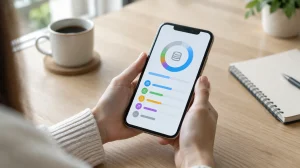
First of all, an important warning: none of the apps on this list treat, cure, or diagnose any health problem. They are apps for... ambient sound, relaxing music, and routine recording. — comfort tools that can help create a sleep ritual, nothing more than that. If difficulty sleeping persists for weeks, disrupts the following day, or is accompanied by anxiety, loud snoring, or pauses in breathing, the best course of action is to see a doctor. No amount of white noise can replace this evaluation.
That said, many people actually sleep better with a constant background sound. The most widely accepted explanation is simple: a stable noise masks sudden noises from the street, neighbors, or the house, which are what usually interrupt light sleep. The effect varies considerably from person to person—for some it works well, for others it's disruptive. It's worth trying.
Below are apps available in official app stores, along with what each one actually does, how much it costs, and who it's for.
The best relaxing sound apps for sleep.
BetterSleep (antigo Relax Melodies)
The app that became known as Relax Melodies is now called BetterSleep. The core idea remains the same, and it's what he does best: creating your own sound mix. You combine rain, a fan, ocean waves, a campfire, and white noise, adjust the volume of each layer separately, and save the mix as a favorite.
In addition to sounds, the app offers narrated bedtime stories, guided meditations, breathing exercises, and a timer that automatically turns everything off after the time you set—a feature that prevents your phone from ringing all night and draining your battery.
How to download: It's available for free on the Google Play Store and the App Store. The basic sound library is free; stories, meditations, and some soundtracks are part of the paid subscription, charged monthly or annually. It's worth checking the current price on the app's page before subscribing.
Pzizz
O Pzizz It follows a different approach: instead of you creating the mix yourself, it generates audio sessions that combine music, sound effects, and calm voice narration. Each session is created on the spot, so it's never the same – the idea is precisely to prevent the brain from getting used to it and stopping paying attention.
There are three modes: one for nighttime, one for a quick nap, and one for daytime concentration. It's straightforward to use—open it, choose the mode, and press play. It's a good app for those who don't have the patience to configure anything.
How to download: Free on the Google Play Store and the App Store, with additional features unlocked through in-app purchases or subscriptions. The free version already allows you to test the basic sessions.
White Noise Lite
O White Noise Lite It is one of the veterans of the category and remains the lightest and most straightforward option. It offers dozens of continuous sounds recorded in high quality: rain on the roof, fan, hairdryer, train, coffee shop, waves, forest at night.
The key features are practical: the sounds play in a seamless, audible loop, you can adjust the pitch of each recording, and there's an alarm clock that wakes you up with a soft sound instead of the standard alarm. It also works well for those who want background noise while studying or working.
How to download: Free on the Google Play Store, with ads. There is a paid version without ads and with a larger sound library.
Calm
O Calm It's more comprehensive than just a sound app: it brings together guided meditations in Portuguese, breathing exercises, instrumental music, and so-called "bedtime stories"—deliberately long and monotonous narratives, read in a low voice, to occupy the mind without holding attention.
It's the choice for those who can't switch off because of racing thoughts, more than because of external noise. The interface is well-designed and the content curation is good, but almost everything is behind the subscription.
How to download: Available on the Google Play Store and the App Store. The download is free and there is initial content available; full access is by monthly or annual subscription.
Headspace
O Headspace It is known for its guided meditation courses, with short, progressive sessions. For sleep, it offers sleepcasts (narrated soundscapes), sleep music, and relaxation exercises before bed.
It works best for those who want to create the habit of winding down half an hour before bed, and not just turning on some music. Much of the content has subtitles and narration in Portuguese.
How to download: Free at official stores, with a trial period and subscription for the full catalog.
Sleep Cycle
O Sleep Cycle It has another function: recording. It uses the microphone and the phone's movement to estimate when you moved, snored, or became more agitated during the night, and creates a graph of the night's events. It also has an alarm clock with a time window and a small library of sounds to help you fall asleep.
It's important to understand the limit: these numbers are indirect estimates These tests, performed by cell phone sensors, are not clinical measurements. They help you notice patterns—for example, you slept worse on days you drank coffee at night—and not to draw any conclusions about your health. A real sleep study (polysomnography) can only be done in a clinic with a doctor's order.
How to download: Available for free on the Google Play Store and the App Store, with advanced features available by subscription.
Sleep as Android
O Sleep as Android It is the most complete in terms of configuration options, which pleases those who like to customize everything. It includes estimated sleep tracking, a smart alarm clock, background sounds with a timer, night noise recording, and integration with watches and wristbands.
The same caveat from the previous item applies: the reports are sensor-based approximations, useful as a diary, not as an examination. The app even has a "wake-up challenge" feature — solving a math problem or scanning a code in the kitchen — which helps those who hit the snooze button ten times.
How to download: Free on the Google Play Store for a trial period; afterwards, a one-time paid license or subscription is required.
Spotify e o app Relógio do Android
Two free alternatives that almost no one remembers. The Spotify It has ready-made playlists of white noise, rain, and ambient piano, as well as a sleep timer hidden in the playback menu — you can program it to turn off at the end of the track or after X minutes.
Already Clock Google's app, which comes pre-installed on many Android devices, has a "Bedtime" tab: you set your bedtime and wake-up time, the phone dims the screen, silences notifications, and can play background sounds until you fall asleep. Zero download, zero subscription.
Veja também:
- The best apps for listening to free music.
- The best free games to download on your cell phone
- Applications to listen to gospel music on your cell phone
How to use these apps without disrupting your sleep.
Using your phone at bedtime has an obvious side effect: the screen and notifications pull you back into the waking world. A few simple adjustments solve most of this.
- Always activate the timer. Playing music all night drains the battery, heats up the device, and can fragment sleep during the lighter phases. 30 to 45 minutes of music is usually enough.
- Low volume, really. The sound only needs to mask the background noise. High volume on headphones, for hours, is a risk to your hearing.
- Keep your cell phone away from your pillow. If possible, place it on the other side of the room, using a small box or the device's own speaker—this avoids the temptation to unlock the screen.
- Activate "Do Not Disturb" mode. Almost all apps keep playing with it on, and you don't receive messages in the middle of the night.
- Download the sounds first. Several apps allow you to save tracks to your device, so the sound won't freeze if the Wi-Fi connection fluctuates overnight.
White, pink, and brown noise: what's the difference?
The apps offer these three options and almost never explain what they mean. The difference lies in how the sound energy is distributed across the frequencies:
- White noise: Equal energy across all frequencies. It's a high-pitched hiss, similar to a TV with no signal or a hairdryer. It masks high-pitched noises well, such as conversation and whistling.
- Pink noise: More energy in the bass frequencies. It resembles constant rain or wind rustling through leaves. It usually sounds more pleasant and is preferred by those who find white music irritating.
- Brown noise: Even deeper, with a muffled sound, similar to a distant waterfall or faraway thunder. Works best against low-frequency noises, such as engines, construction, and heavy traffic.
There's no clear winner: the choice comes down to personal taste and the type of noise that bothers you in your room. Since all the apps mentioned offer three variations, the most practical approach is to test one each night and see which one is least bothersome.
Which helps as much as (or more than) the app.
The habits surrounding bedtime often weigh more heavily than any soundtrack. It's worth taking care of them before signing up for anything.
- Maintain a similar bedtime and wake-up time, including on weekends.
- Reduce caffeine intake starting in the late afternoon — coffee, black tea, cola-based soft drinks, and energy drinks.
- Have a lighter dinner and avoid heavy meals close to bedtime.
- Keep the room dark and cool, and dim the lights in the last hour of the day.
- Engage in physical activity during the day, avoiding intense exercise shortly before bedtime.
Common questions
Esses aplicativos curam insônia?
No. They offer sound and routine, which can make bedtime more comfortable. Persistent insomnia is a health condition and requires professional evaluation—which can identify causes such as anxiety, sleep apnea, medication use, or circadian rhythm disorder.
Os gráficos de sono são confiáveis?
These are estimates. The phone infers what happened from sound and movement, without measuring brain waves, oxygenation, or heart rate using clinical standards. Use it as a diary to observe trends, never as a result of an examination.
Preciso pagar assinatura para ter um som bom?
No. The free versions of BetterSleep and White Noise Lite, Spotify playlists, and the "Bedtime" tab in the Android Clock app already cover most people's needs. Subscribing makes sense when you want guided meditation or narrated stories.
Ruído branco funciona para todo mundo?
No. Some people sleep better in absolute silence and are bothered by any continuous sound. Since the apps are free to try, you can experiment for a few nights and compare.
Posso usar com fone de ouvido a noite toda?
It's not recommended. Besides the risk to your hearing from listening at high volume for many hours, headphones are uncomfortable when turning over in bed. Opt instead for your phone's speakerphone or a small speaker, always with a timer.
Conclusion
The apps on this list do one thing well: transform the bedroom into a more predictable environment and help create an end-of-day ritual. BetterSleep and White Noise Lite are perfect for those who just want the right sound; Calm and Headspace are better for those with restless minds; Sleep Cycle and Sleep as Android are useful for tracking patterns over the weeks. And the Android Clock app does the basics for free.
None of them treat disease. This content is for informational purposes only and does not replace the advice of a healthcare professional: if you have persistent difficulty sleeping, daytime sleepiness, loud snoring, or pauses in breathing, see a doctor.