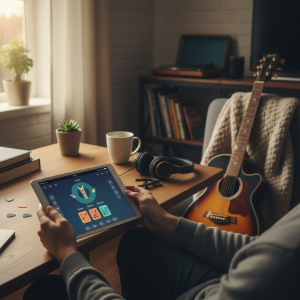
Music is a universal form of expression that touches everyone's heart. It is something that is present in our lives from birth to old age, and, for many, it is a way of escaping the real world.
With the popularization of smartphones and ease of internet access, it is possible to listen to music for free and without advertising interruptions, through applications. In this article, we will present the best apps for listening to free music.
The Best Apps to Listen to Free Music
Spotify
Spotify is one of the most well-known and popular free music apps. With over 200 million active users around the world, it offers a huge amount of music, including popular songs and new releases.
Additionally, it allows you to create your own playlists and share them with your friends. The app also offers a free version, which includes ads but still allows you to listen to music without interruptions.
Available on Android It is iOS
SoundCloud
SoundCloud is another popular app for listening to free music. It allows you to discover new music and artists, as well as listen to music from lesser-known artists.
SoundCloud also offers a free version, which is ad-supported, but still allows you to listen to music without interruptions.
Additionally, you can share your playlists with your friends and follow other users to discover new music.
Available on Android It is iOS
Jango Radio
Jango Radio is a personalized radio app that lets you listen to free music. With Jango Radio you can create your own radio stations based on your favorite artists and listen to music without advertising interruptions.
Additionally, the app offers recommendations based on your music tastes and lets you discover new music and artists. The free version of Jango Radio includes ads, but it's still a great option for listening to music for free.
Available on Android.
Youtube Music
Youtube music is a music app from Google that allows you to listen to free music and upload your own music. It offers a large amount of music, including popular and new songs.
Additionally, you can create your own playlists and share them with your friends. The free version of Youtube Music includes ads, but it's still a great option for listening to music for free.
Available on Android It is iOS
Frequently Asked Questions about the Best Apps to Listen to Free Music
Qual é o melhor aplicativo para ouvir música grátis?
There is no single best app for listening to free music, as it depends on each person's musical tastes and needs. Some of the best applications to listen to free music include Spotify, SoundCloud, Jango Radio and Google Play Music.
It is important to try each of them and choose the one that best suits your needs.
Os aplicativos de música grátis sempre incluem anúncios?
In most cases, yes. Most free music apps include ads, but that doesn't stop you from listening to music without interruptions. If you don't like ads, you can opt for a paid, ad-free version of a music app.
Posso compartilhar minhas playlists com amigos em aplicativos de música grátis?
Yes, in most cases you can share your playlists with friends on free music apps. Some of the best apps for listening music Free downloads like Spotify and SoundCloud allow you to share your playlists with your friends and follow other users to discover new music and playlists.
Veja também:
- How to put music on Whatsapp status?
- Exploring new musical horizons: Apps to discover music
- Apps for playing guitar: 4 best options
Posso fazer download de músicas em aplicativos de música grátis?
This depends on the application you are using. Some apps, like SoundCloud, let you download music for free, while others, like Spotify, only let you download music for offline listening with a paid subscription.
It's important to check each app's policies before downloading music.
Conclusion
The best apps for listening to free music offer a large amount of music for you to listen to without paying anything. Some of the best apps include Spotify, SoundCloud, Jango Radio, and Google Play Music.
Each of these apps has its own advantages and disadvantages, so it's important to try each one and choose the one that best suits your needs. With so many apps available, it's now easier than ever to listen to free music on your mobile device or computer.
How to choose between the options
- What the free version offers. Generally, it's ad-supported playback, shuffled order, and limited skips. Offline listening and track selection are usually paid services.
- Catalog in Portuguese and local format. International streaming services sometimes have glitches in sertanejo, forró, and gospel music. If that's what you listen to, test it before subscribing.
- Audio quality available. The bit rate varies by plan. On standard headphones the difference is subtle; on better equipment, it's noticeable.
- Data usage. Streaming in high quality consumes a lot of data. Adjusting the quality on your phone will prevent surprises when it reaches your data limit.
What these apps don't do
This is the part that almost no list mentions, and it's precisely what separates expectation from result.
- Tracks are removed from the catalog when the license expires, including tracks from pre-made playlists.
- Losing your subscription means losing access to what you downloaded — it's not a purchase, it's a usage license.
- They don't allow downloading the music as a free file. The download is within the application and requires an active subscription.
- An app that offers paid content for free is piracy and often comes with intrusive advertising or malware.
How to use it in practice
- Migrate your playlists when switching services. There are tools for transferring data between platforms; the loss is usually only due to unavailable tracks.
- Let the app learn. Liking and skipping are key to the recommendation. Two weeks of use significantly changes what appears.
- Reduce the quality of mobile data. In the settings, separate Wi-Fi quality from data quality. This cuts consumption in half.
- Download playlists via Wi-Fi. Get it ready before you leave. The download is within the app and depends on an active subscription.
What goes wrong most often?
- Listen in high quality using mobile data and exceed your data allowance.
- Cancel your subscription and lose access to all downloaded data.
- Losing created playlists when switching accounts instead of transferring them.
- Signing up for the family plan without checking the requirement for a shared address.
The alternative that is already included in the system
YouTube functions as a huge free catalog for discovering music, and streaming radio continues to exist within various free apps. For offline listening without a subscription, your own files still play in the system's native player.
What does "free" mean in each model?
There are four legitimate ways to listen to music for free, and they work according to different logics. Confusing them is the reason for almost all disappointment.
- Freemium with ads. The service has the complete catalog and pays the record labels with advertising revenue. You can listen for free, but with commercial interruptions and control restrictions.
- Radio via the internet. Continuous transmission, without channel selection. Radio licensing is simpler and cheaper than catalog-on-demand, and therefore the model is sustainable without charging you anything.
- Music video. Video platforms function as a music source because the artist or record label has published the material there. Audio is secondary, and data consumption is much higher.
- Free catalog. Works in the public domain or published under an open license. No ads, no limits, and with the right to use them in your own video.
None of these models delivers a complete catalog, ad-free, offline, and free of charge at the same time. When an app promises exactly that, it's outside the four—and outside the law.
The actual limits of the no-subscription plan.
Restrictions vary from service to service, but they are similar in format. Knowing what they are prevents you from searching for a button that doesn't exist.
- Mandatory random order on mobile. On several services, the free version doesn't let you choose the exact track within a playlist. You request the artist and receive a similar selection.
- Limited number of jumps per hour. A direct legacy of the radio model, which exists due to licensing requirements.
- No download required. Offline listening is almost always a feature reserved for paid plans, because the downloaded file is what most concerns record labels.
- Lower audio quality. The free version usually crashes at a lower bitrate.
- Lock screen when it turns off. Some video apps stop playback when the phone is locked. This is a business restriction, not a defect.
- Audio and on-screen announcements. It usually appears every three or four tracks.
A warning is in order regarding ad blockers and modified versions of popular apps distributed outside of official app stores. Besides violating the terms of service, these files are one of the most common vectors for malware on Android because they require you to disable the system's installation protection and grant broad permissions to an unknown installer.
Music that is legally free to listen to and use.
There's a huge catalog outside the record label circuit, and it's underutilized because almost nobody knows it exists.
- Public domain. In Brazil, the copyright of a work expires 70 years after January 1st following the author's death. This frees up the entire classical repertoire and a good part of the old songbook. Note one detail: a composition being in the public domain does not automatically free up a recent recording of it, because performance rights are separate.
- Open licenses. Many artists publish under licenses that authorize use, sometimes requiring only attribution. Libraries dedicated to this type of collection gather thousands of tracks by genre.
- Institutional archives. National libraries, universities, and museums have digitized historical sound archives and made them available for free.
- Independent artists. Platforms where the musician themselves publishes and chooses to release the download.
For those who make videos, this is the only source that solves the soundtrack problem without automatically blocking them due to content identification. And, for those who just want to listen, it's a real catalog, not a sample.
Download from the platform: why there is no legal way
Websites and apps that convert tracks from streaming or video services into files are sought after precisely by those who want to listen offline without paying. Three concrete problems:
- Contractual and legal. Removing the banner bypasses the technical protection of the service and reproduces protected work without authorization. This is not a grey area.
- Security. This is one of the niches most exploited by online fraud. These pages thrive on aggressive redirects, forced notifications, malicious extensions, and fake virus alerts.
- Quality. The generated file comes from already compressed audio and is compressed again. The result is worse than any medium-quality stream.
The honest alternative to offline streaming is to buy the tracks from a digital store, which delivers the final file, or subscribe to a one-month service for periods when you will actually need the feature.
The invisible cost of free: data, battery, and privacy.
Listening for free has a price in other currencies, and it's possible to reduce all of them.
Data. Medium-quality audio consumes around 70 MB per hour; high-quality audio consumes about 144 MB. If the source is video, consumption jumps to 300 MB to over 1 GB per hour, because the image travels along even with the screen off. Replacing video with audio is the easiest way to save money.
Battery. What consumes the most power is not the sound, but the screen and the network. Playing with the screen off, on Wi-Fi, and with the app in standard quality significantly extends battery life. Video ads, on the other hand, turn on the screen and reactivate the network at each interval.
Privacy. The free model is supported by targeted advertising. It's worth opening up the app's permissions and revoking what doesn't make sense—precise location and contacts are rarely needed to play music. In the system settings, there's also the option to limit personalized advertising and reset the advertising identifier, which reduces some tracking without breaking anything.
Finally, a simple habit: periodically review which audio applications are still installed. Abandoned services continue running in the background, syncing and consuming data for months without anyone noticing.