We would all like to be able to record the screen of our Android cell phone. However, interestingly, unless we have a Xiaomi or Huawei phone, there is no built-in function to make such recordings. Therefore, resort to apps to record the screen is the best option.
In this short article, we will show you the main apps to record the screen. They are all lightweight, simple to use and very useful.
4 best apps to record your screen
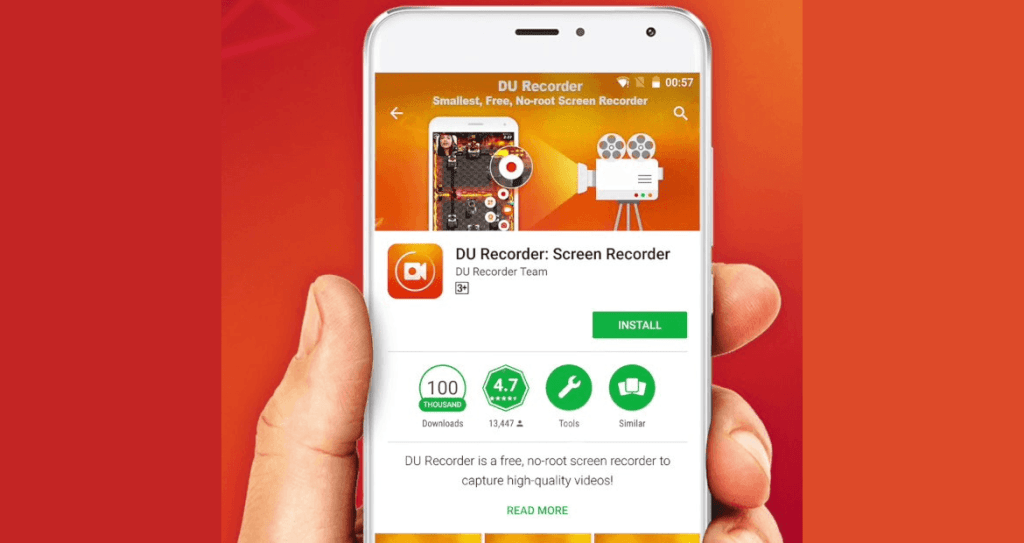
DU Recorder – Screen Recorder
Launched at the end of 2016 on the Google Play Store, DU Recorder imposes strong competition on the most renowned applications. The tool draws its strength from its floating bubble, providing quick access to screen video recording without having to leave the app in use.
Highly configurable, DU Recorder lets you decide on the quality of videos done.
Full HD resolution, transfer rate, number of frames per second and sound support, all options are configurable according to your needs.
Finally, there are some built-in editing tools that allow you to create animated gifs in real time or instantly transfer videos to your computer over Wi-Fi.
Mobizen gravador de tela
Visually similar to DU Recorder, O Mobizen Screen recorder does a very satisfactory job, as long as we are comfortable watching advertising. The floating bubble facilitates instant video recordings, but also access to gallery and app settings.
Like DU Recorder, the tool allows you to control the Full HD resolution of recordings, the number of frames per second, and the bitrate.
Support for the front camera allows you to use PiP mode, and the built-in editor offers many editing options, supporting trimming videos, adding music, and creating intro.
AZ Gravador de Tela
O AZ recorder Screen recording also features the integration of a floating bubble to quickly access your screen recording options.
In addition to the features traditionally integrated into video capture applications (resolution, IPS, bitrate, sound and support management), the tool offers the possibility of configuring the encoder used in case of green screen problems.
AZ screen recorder borders on perfection as long as you subscribe to the premium version. However, there's no need to dig into your wallet if you aspire to basic use of the app, whose free features are more than enough to take quality captures.
Gravador de tela – XRecorder
Another interesting option for recording your cell phone screen is Screen Recorder. This free app allows you to not only make a video but also broadcast live on platforms like Facebook, YouTube or Twitter.
One of the strengths of this application is its floating interface. Thanks to this, you can record your video quickly and intuitively.
Additionally, the app allows you to save your video in GIF format and edit it directly from your phone, which is especially useful if you don't want to waste time downloading it to your PC.
See too:
Applications to find out what the song is by sound
Menstrual and fertility calendar apps
What to look for before installing
- What the app actually does. Compare the description on the store page with recent reviews. The difference between the two often reveals what the advertisement omits.
- Billing model. Check if it's free with ads, pay-per-view, or subscription-based — and the price range for in-app purchases.
- It works offline. If the task is local, requiring a connection means that your data is being sent to a server.
- Permissions requested. An app should only request what it needs to function. Requests for access to contacts, messages, or accessibility without reason are a red flag.
What these apps don't do
Before installing, it's worth managing your expectations: there are things that no app in this category delivers.
- They can't do what the device's hardware doesn't allow. A feature without a corresponding sensor doesn't exist in software.
- The free version often limits exports, applies a watermark, or restricts the number of uses per day.
- A high rating in the store doesn't guarantee quality: it's worth reading recent, negative reviews.
- An app that promises impossible results usually exists only to display advertising.
Common questions
Is there a native alternative?
It's worth checking out. Android and iOS come with several ready-made functions that eliminate the need to install another app.
Does it consume a lot of battery?
Check the usage per app in the settings and restrict background activity for any that are high.
Does it work without internet?
It depends: those that process on the device work offline; those that depend on a server require an internet connection.
Is it safe to install?
Download from the official store, check the developer, the date of the last update, and the permissions requested.
Is the app free?
Generally, the download is limited or may include advertising. Check the price range for in-app purchases on the store page.
Step-by-step to get started
- Check if it works offline. If the task is local but still requires a connection, your data is being sent to a server.
- Review your consumption after one week. In the settings, view battery and data usage by app and restrict any that are high.
- Check what the app asks for during installation. Compare the permissions with what it actually does. It's the quickest test of trustworthiness.
- Try the free version before you pay. Check if the feature you want is outside the free plan—it usually is.
Traps that catch almost everyone
- Choosing based on average rating without reading recent negative reviews.
- Installing multiple applications that do the same thing, all running in the background.
- Ignore the fact that the free version limits exports or applies a watermark.
- Believing in a feature that the device's hardware does not support.
The alternative that is already included in the system
It's worth opening the search in your phone's settings before installing: Android and iPhone already have several built-in functions, and the native app usually consumes less battery and doesn't ask for any permissions beyond what's necessary.
Why does the recording come out black in some apps?
You record the screen, review the file, and the video is either completely black, or has a dark rectangle in place of the content. It's not a bug, and changing recorders won't help.
The operating system offers a flag that any application can activate to say "my content cannot be captured". On Android it's called FLAG_SECURE; the iPhone has an equivalent mechanism. When it's enabled, the system delivers a black screen to recorders and screen capture applications, and no third-party application can bypass this without modifying the system.
Who typically uses this type of protection:
- Video streaming services, as required by the distribution agreements for protected content.
- Banking and payment apps, to make fraud through remote access more difficult.
- Messengers in conversations with temporary messages and authentication screens.
- Corporate applications with the company's security policy.
The practical conclusion: screen recording is useful for tutorials, app errors, game sessions, video calls with consent, and demonstrations. It's not suitable for copying movies or series — and any tool that promises this either doesn't work or requires you to compromise the security of your device.
Internal audio, microphone, and both at the same time.
The biggest source of frustration after a black screen is the sound. There are three possible origins, and they behave differently:
- Internal audio. The sound produced by applications. On Android, capturing internal audio became possible starting with Android 10, but the application playing the audio may refuse to capture it. That's why a game might record sound while a music service might not.
- Microphone. It captures your voice and the environment. It works in virtually any situation, including when the internal sound is blocked — but it also records the fan noise.
- The two combined. Ideal for narrated tutorials. It's worth checking if the recorder allows you to adjust the balance, because the system audio often muffles the voice.
Two tips that greatly improve quality without equipment: use headphones with a microphone, which brings the recording closer to the mouth and reduces echo, and record in a room with curtains, a sofa, or a bed—a soft surface absorbs the reverberation that makes the narration sound amateurish.
Recording calls is another story.
Recording a conversation in which you participate is considered legal in Brazil, and the Supreme Federal Court has already established this understanding, except in cases of confidentiality. However, recording someone else's conversation without participating constitutes illegal interception.
From a technical standpoint, Android has blocked third-party applications from accessing call audio since version 10, and the iPhone has never allowed this. Therefore, most "call recorders" in the store only capture what comes through the speakerphone—and that's why many stopped working suddenly. Some manufacturers offer the feature in the native dialer, with a mandatory audible notification for the other party.
Resolution, frame rate, and file size.
Screen recorder generates large files quickly. The cost depends on three variables:
- Resolution. Recording in 1080p is sufficient for practically everything. Recording in 1440p or 4K on a cell phone multiplies the file size without any visible gain for those who will watch it on their cell phone.
- Frame rate. 30 fps is sufficient for tutorials, navigation, and app demonstrations. 60 fps is only worthwhile in games with fast-paced movement, and it doubles the processing power.
- Bitrate. It's the control that truly defines size and sharpness. At 1080p at 30 fps, something between 8 and 12 Mbps already delivers a clean image, which is approximately 60 to 90 MB per minute.
Rule of thumb: ten minutes of 1080p recording takes up about 1 GB. Before recording anything long, check your free space—recordings that fill up halfway through usually result in corrupted files, not shorter videos.
If your phone overheats and the image stutters, reduce the resolution to 720p and 30 fps. Overheating causes the processor to reduce performance and is the most common cause of choppy recording on mid-range devices.
Prepare your phone before pressing the button.
Five minutes of preparation can prevent you from having to redo the entire recording:
- Activate Do Not Disturb mode. Notifications appearing in the middle of a video are the number one flaw, and they frequently expose private conversations.
- Close resource-intensive applications. And restart your phone if it has been on for days. Freeing up memory reduces freezing.
- Adjust the screen timeout so it doesn't delete in the middle of recording.
- Turn on visible touch. If it's a tutorial, Android has this option in the developer tools, and it shows a circle where the finger touches, which makes a huge difference for the viewer.
- Clear the status bar. Battery in 4%, dozens of icons and the network name appear in all frames.
- Try the route once. Before recording. Video with hesitation and backtracking is tiring and requires editing.
After recording: cut, compress, and publish.
The raw file is almost never the final file. Three operations resolve most cases and are available on the phone itself:
- Cut from beginning to end. The Android and iPhone gallery already allows trimming without installing anything, and simple trimming doesn't recompress the video, so there's no loss.
- Compression. If the file needs to be sent via message or email, reducing the resolution when exporting drastically cuts the size. Sending via cloud link preserves the original quality; sending via messaging app always recompresses.
- Hide sensitive information. Before publishing, review the entire recording, looking for phone numbers, email addresses, balances, physical addresses, and contact names. Simple editors allow you to cover sections with a rectangle or blur.
One privacy note that's worth more than any adjustment: screen recording captures everything that appears, including what you didn't intend to show. Reviewing the video before uploading takes the same amount of time as recording and avoids the kind of exposure that can't be undone once published.