First and foremost, the most important thing: no mobile app can perform a pregnancy test. Only a home pregnancy test or a blood test (beta-hCG) confirms a pregnancy, because both detect the hCG hormone in the body—something that no camera, questionnaire, or algorithm can do. The apps on this list serve a different purpose: To track the menstrual cycle, organize symptoms, and estimate periods.. These are tools for recording and estimation, not for diagnosis. If you suspect you are pregnant, see a doctor.
That said, these apps are truly useful. Those who have been tracking their cycle for a few months notice delays much more clearly, know exactly how many days their period has been late, and arrive at the appointment with a timeline ready instead of "I think it was at the beginning of last month." It's this organization that helps decide the right time to take a home pregnancy test—and that's what we're going to show you here, without any magical promises.
What these apps actually do (and what they don't do)
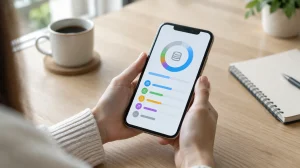
A menstrual cycle tracking app works with what you type. You mark the first and last day of your period, note symptoms (cramps, nausea, breast tenderness, mood swings, basal body temperature), and the app cross-references these records with your history from previous months. From there, it calculates a... statistical forecastWhen is your next period expected and what is your likely fertile window?.
It's important to understand the limitations of this prediction. Cycles vary with stress, sleep, exercise, diet, travel, medication use, and health conditions like polycystic ovary syndrome. Therefore, the date shown on the screen is an estimate, not a commitment from the body. And most importantly: This list of symptoms does not mean pregnancy.. Nausea, fatigue, sore breasts, and delayed menstruation can occur in dozens of different situations, including common premenstrual tension.
- They do: Keep track of cycle dates, identify patterns throughout the months, remember to take birth control, estimate the fertile window, and organize symptoms to bring to the doctor's appointment.
- They don't: Detect hormones, confirm pregnancy, give a diagnosis, replace pharmacy tests, replace blood tests, replace ultrasounds, replace doctor's appointments.
The best apps for tracking your cycle and symptoms.
All the apps below are available in official app stores and can be installed for free via Google Play or the App Store. None of them promise pregnancy results—and that's precisely why they're on this list.
Flo — Calendário Menstrual
Flo is the world's most popular and comprehensive cycle tracking app. You log your period, flow, mood, sleep, and physical symptoms, and it creates charts showing how your cycle behaves over the months. It also has a large library of professionally peer-reviewed articles on reproductive health.
What Flo actually offers is organization and statistical forecasting. When there's a delay, it alerts you that your cycle has passed the expected date—and that's the time to buy a pregnancy test. The app doesn't conclude anything about pregnancy, and the free version already covers the essentials. Download on Google Play.
Clue — Calendário Menstrual
Clue is known for its understated approach: minimal color, no childish language, and a focus on data. It was created through a partnership with researchers and clearly shows variations in your cycle, which is very helpful for those with irregular cycles who need to share this information with their gynecologist.
The interface allows you to record dozens of symptoms in just a few taps and export your history. For those who want to understand their own body without any hassle, it's the best choice. Download on Google Play.
Ovia Fertility
Ovia Fertility is designed for those trying to conceive. In addition to the calendar, it tracks basal body temperature, cervical mucus, and results from ovulation tests purchased at the pharmacy—in other words, it... registers What a physical test showed, instead of fabricating a result.
That's the difference that matters: Ovia organizes real evidence collected outside of the mobile phone. Download on Google Play.
Premom — Ovulação e Fertilidade
Premom allows you to photograph ovulation test strips and track the evolution of the line's intensity over the days. Again: the data comes from the physical test; the app only saves, sorts, and displays the trend.
It's a good option for those already undergoing fertility treatment who want an organized visual record to show at the doctor's office. Download on Google Play.
Period Tracker
Simple, lightweight, and old-fashioned in a good way: Period Tracker does the basics very well. It tracks your period days, calculates your average cycle length, protects the app with a password, and works well on more modest phones without requiring elaborate registration.
If you just want to know when it arrived and when it should arrive, without any extra content, this is the right choice. Download on Google Play.
Gravidez+ (semana a semana)
This one comes later: it's for when the pregnancy has already been confirmed by a test or exam. It tracks development week by week, keeps track of appointment dates, and helps create a list of questions for prenatal care.
It's worth installing now if you're trying to get pregnant, but it doesn't determine if you're already pregnant. Download on Google Play. If you want to delve deeper into this phase, also check out our list of apps to track pregnancy.
How is a real pregnancy confirmed?
There are three real paths, and they all go outside the phone:
- Pharmacy test (urine). It detects the hCG hormone in urine. It is inexpensive, sold without a prescription, and tends to be more accurate when done from the first day of a missed period, using the first urine of the day. A very early negative result may change days later.
- Beta-hCG blood test. Made in a laboratory, it is the most sensitive: it detects pregnancy earlier and also indicates the amount of the hormone. In Brazil, it can be requested through the public health system at basic health units.
- Consultation and ultrasound. It is the doctor who confirms the pregnancy, estimates the gestational age, and initiates prenatal care. None of the previous steps replace this one.
In the Brazilian Unified Health System (SUS), initial care takes place at the Basic Health Unit closest to your home, and prenatal care is free. Official information about women's health and prenatal care can be found on the portal of [website name - missing from original text]. Ministry of Health.
What is the right time to take the test?
This is where the app really helps. Because it stores the date of your last period and the average length of your cycles, it's easy to know how many days late you are — and that number determines the best time to take a pregnancy test.
Testing too early is the most common cause of a false negative. The hCG hormone begins to appear in detectable quantities a few days after implantation, and each brand of test has a different sensitivity, indicated on the packaging. Therefore, the practical advice is to wait for a missed period: if the test is negative and menstruation still hasn't arrived, repeat it after a few days or take a blood test, which detects it earlier.
It's important to remember that irregular cycles make the "delay" calculation inaccurate — if your period varies significantly from month to month, the app will frequently miscalculate, and talking to a gynecologist is more helpful than any estimate on the screen. And if there is severe pain, unusual bleeding, or fainting, this is not a case for the app: seek medical attention immediately.
Beware of "online pregnancy test" scams.“
This type of search attracts a lot of fraud, precisely because it involves anxiety. It's worth knowing the most common patterns before falling for one of them:
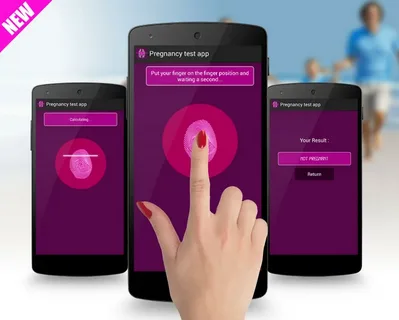
- An app that promises "immediate results". It doesn't exist. If an app claims to analyze symptoms and conclude whether you're pregnant, it's making it up—usually to display ads or push a subscription.
- APK not available in the store. Websites that offer "the complete app" as a file for direct download are the main entry point for malware on Android. Always install from Google Play or the App Store.
- Hidden signature. Some apps offer a 3-day "free trial" and then charge a high price. Before accepting, check the price on the app store page and cancel through your Google Play or App Store account.
- Too much data requested. A cycling app doesn't need your CPF (Brazilian tax ID), your contacts, your WhatsApp, or a photo of your ID. If it asks for it, uninstall it.
- “"Free consultation" via social media link. Profiles claiming to be clinics and asking for upfront payment via PIX (Brazilian instant payment system) to "schedule an exam" are a classic scam. Contact the healthcare facility directly.
Privacy: Your health data is very valuable.
Menstrual cycle data is considered sensitive data under the General Data Protection Law. Before choosing an app, open its page in the app store and read the "Data Security" section, which explains what data is collected and whether it is shared with third parties.
Three simple habits significantly reduce the risk: enable password or biometric locking within the app itself, disable advertising sharing when the option exists in the settings, and avoid logging in with social networks — prefer email. If you decide to stop using it, delete your account through the app's settings before uninstalling, because uninstalling alone does not delete what remains on the server.
How to install safely
On Android, open Google Play, search for the app's exact name, and check the developer before tapping "Install"—there are many copies with similar names. On iPhone, the process is the same through the App Store. Be wary of any website that asks you to enable "unknown sources" or download a file: legitimate health apps are found in official app stores.
Common questions
Is there an app that does pregnancy tests using the camera? No. Cell phone cameras do not detect hormones. Apps that claim otherwise are false.
And what about the app that reads the photo from the pharmacy pregnancy test? Some apps help to record the photo of the test, but the physical test itself produced the result. If the line is faint or you are unsure, repeat the test a few days later or get a beta-hCG test.
The app got my date wrong. Is that normal? Yes. The forecast is statistical and depends on the data you recorded. The more months of historical data you have, the more stable the estimate becomes.
Can it be used as a method of contraception? No. The calculated fertile window is an estimate and does not protect against pregnancy or sexually transmitted infections. Contraceptive methods should be discussed with a healthcare professional.
Are these apps free? All have a functional free version. Advanced features are usually paid for by subscription, with the price listed on the store's page.
Conclusion
Menstrual cycle tracking apps are great tools for getting to know your own body, accurately noticing delays down to the nearest day, and arriving at your appointment with organized information. Flo, Clue, Ovia, Premom, Period Tracker, and Gravidez+ fulfill this role well and are available for free in official app stores.
What they don't do — and no app does — is confirm a pregnancy. For that, there are home pregnancy tests, beta-hCG blood tests, and doctor's appointments. Use your phone to stay organized and be wary of any promises of results on the screen: the answer that matters comes from a real test.