Before drilling any holes in the wall, it's worth knowing about a limitation that almost no app ad mentions: The cell phone doesn't have radar and can't see through walls.. The only sensor it has that reacts to metal is the magnetometer — the device's compass. It detects ferrous metal (steel, iron) at a depth of a few centimeters and does not detect PVC pipe, This refers to the material used in most Brazilian residential plumbing. No app accurately measures pipe depth, and none should be used as the final criterion for deciding where to drill.
That said, the subject remains useful—and solvable. There are real apps that help map metal points, there are visual signs that indicate where the piping runs, there are installation rules stipulated in regulations that greatly reduce the risk, and there are real tools for those who need safety. This guide brings all of this together, in the order in which it is used in practice.
What the cell phone can and cannot detect.
Understanding the sensor prevents false expectations. The magnetometer measures variations in the magnetic field around the device. When an iron or steel object approaches, the reading changes — and it is this variation that the applications convert into a number, graph, or beep.
What usually gives this warning:
- Shallow metal pipes and conduits.
- Screws, nails, corner brackets and metal profiles for drywall.
- Junction boxes and metal electrical panels.
- Reinforcing bars in slabs and beams (near the surface).
What gives no signal at all:
- PVC pipe, PEX or CPVC — that is, most water pipes in modern houses and apartments.
- Electrical wire inside a plastic conduit with no significant current flowing through it.
- Anything more than a few centimeters deep, under thick siding or heavy plaster.
- Copper, aluminum, brass, and other non-ferrous metals do not alter the magnetic field in this way.
Note the magnitude of the problem: the most common material in hydraulics is precisely what the cell phone doesn't see. That's why the app serves as a clue, never as a guarantee.
Real-world apps that use the phone's sensor.
These apps exist, they're in official app stores, and they're honest about what they do. Use them to locate metal objects and rule out obviously dangerous areas—not to authorize drilling.
1. Metal Detector (Smart Tools)
It's the best-known app in its category and one of the most transparent. It displays the magnetic field strength in microtesla and beeps as the reading increases. The app's own description states that... It does not detect gold, silver, or copper coins., Because they are non-ferrous metals, their readings are affected by household appliances, computers, and microwaves. They are useful for locating drywall metal profiles and steel conduits. Available at [website/store name]. Google Play.
2. Smart Tools
A utility package from the same developer, which includes a metal detector, bubble level, protractor, ruler, angle distance meter, compass, and flashlight. For those doing renovations, it's useful precisely because of the combination: the level and protractor help to mark the wall correctly before drilling any holes. Available at [website/store name]. Google Play.
3. Sound Meter (Smart Tools)
It may seem out of context, but it has real-world use in leak detection: with the house quiet and the main water shut-off valve open, a sound level meter helps compare the noise in different sections of the wall. It doesn't pinpoint the pipe precisely, but it indicates where there is more noise—something plumbers do with professional geophone equipment. Available at [website/store name]. Google Play.
4. FLIR One
This is the only way to detect PVC pipes using your cell phone — but it requires an accessory: a thermal camera that connects to the phone's port. The logic is indirect and it works: if you turn on the hot water for a few minutes, the section of the wall where the pipe runs heats up a little, and the thermal camera reveals the path. The same applies to finding leaks, where the damp area appears cooler. The app is free, the accessory is not. Available on [website/platform name]. Google Play.
How to use your cell phone's detector without drawing the wrong conclusions.
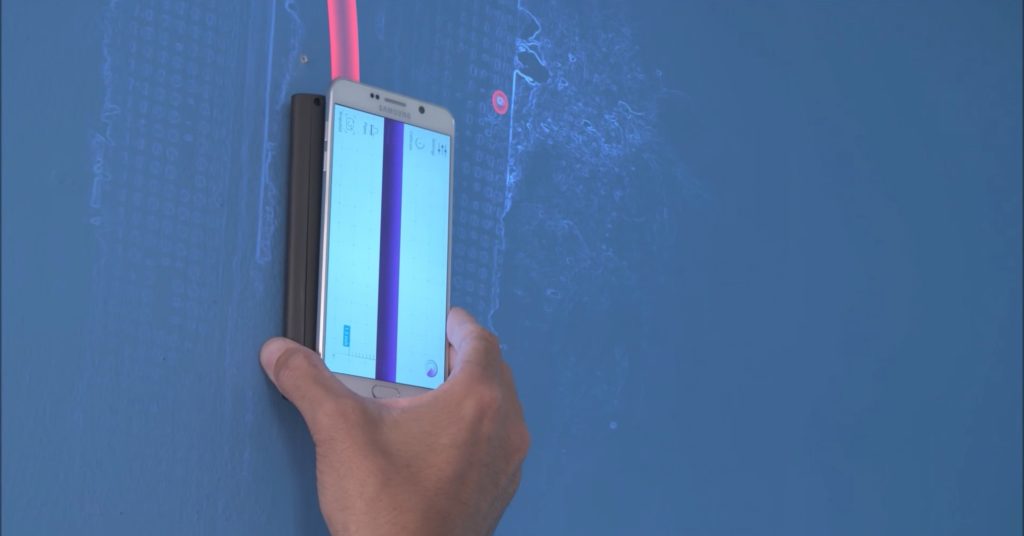
The app performs better when you treat it as a comparator, not a scanner. The procedure below greatly reduces the number of false signals.
- Remove the phone case., Especially those with magnetic closures or magnetic backings—they completely ruin the reading experience.
- Calibrate the compass. moving the figure-eight shaped device in the air, away from the wall.
- Measure the reference value. In the middle of the room, away from everything. Write down the base number.
- Turn off whatever you can.Microwave oven, router, computer, speaker. They all create a magnetic field.
- Slowly pass the phone over your phone., leaning against the wall, in horizontal strips, from top to bottom.
- Mark with a pencil Every point where the value rises well above the reference point, and then reverse the path to confirm.
- Repeat the vertical measurement.. The intersection of the two lines shows the truly suspicious area.
If a signal appears, great: you've found metal. If nothing appears, that's... no This means the wall is clear — there might be PVC right there.
Visual signs that indicate piping without any equipment.
Much of the work involves observation. Plumbing and electrical installations follow a logical pattern, and that logic is predictable.
- Go up and down from the existing points. Faucet, shower, tap, toilet, washing machine: the pipes reach them in mostly vertical routes.
- Align with outlets and switches. Electrical wiring typically runs vertically up to the electrical panel and horizontally at standard height. Do not drill directly above or below an electrical outlet.
- Notice the wet bathroom wall. The side opposite a shower stall almost always has plumbing pipes concentrated in it.
- Look for the patch. Plaster with a slightly different texture or color usually indicates a cut made after the masonry work—exactly where the pipe passed through.
- Knock on the wall. A hollow sound in a continuous band may indicate a void or a filled tear.
- Consult the project. In buildings, the administration usually has the plumbing and electrical plans. It's the most reliable and free information available.
The areas where drilling is not allowed.
As a rule of thumb for safety, avoid drilling into: the vertical strip above and below electrical outlets and switches; the horizontal strip at the height of outlets; the area around faucets and showerheads; and the area immediately above the sink and laundry tub. If drilling is unavoidable in these areas, turn off the circuit breaker and shut off the water supply first—and drill with extreme caution.
The type of wall changes everything.
One detail that often goes unnoticed: the same app gives completely different results depending on the wall material. It's worth identifying what you're dealing with before trusting any reading.
- Brick masonry with plaster: This is the most common case in Brazil and the most difficult. The pipe is inside a groove filled with mortar, often five centimeters or more from the surface — a depth that already compromises the magnetometer reading.
- Drywall: The most favorable aspect for the cell phone. The metal profiles appear clearly and form a regular pattern, generally every 40 or 60 centimeters. Finding this pattern helps to deduce where there is open space and where there is structure.
- Concrete and structural wall: Filled with iron rebar, this saturates the sensor and produces an almost continuous signal. At this point, the app becomes useless, and drilling requires extra care—structural walls should never be drilled deep without technical guidance.
- Wall with ceramic tile cladding: The tile distances the sensor from what's behind it, and there may also be grout with interfering components. This is precisely the scenario in bathrooms and kitchens, where there is more plumbing.
- Walls with underfloor heating or radiant floor heating: Consulting the project plan is mandatory because the network crosses entire areas.
In short: the thicker the coating and the denser the material, the less likely the cell phone is to help. It's reasonable on drywall; practically useless on concrete.
The real tools for those who need security.
When the hole is large, when there is suspicion of a leak, or when a mistake would be costly, the solution is dedicated equipment. The options, in order of cost:
Electronic wall detector
Handheld devices sold in hardware stores at affordable prices. Common models identify metal, wood, and live wiring. They are not infallible—they can be wrong on very damp walls or walls with thick plaster—but they are far more reliable than any cell phone because they were designed precisely for this purpose.
Non-contact voltage detector
A cheap pen that beeps near live wires. It won't locate pipes, but it solves the most serious risk on the list: puncturing electrical wiring. Worth having at home.
Thermal camera
As mentioned before, it reveals the path of hot water and areas of infiltration. There are models that connect to a cell phone and stand-alone models. It's the tool that "sees" PVC—indirectly, through heat.
Professional wall scanner and geophone.
Equipment used by leak detection companies, with penetrating radar or amplified listening devices. Hiring this service usually costs less than tearing up the entire bathroom floor in the wrong place.
When to call a professional
Call a qualified professional if you encounter any of these scenarios: a damp stain that grows unexplained; a water bill significantly higher than average despite all taps being shut off; the need for a deep hole in a structural wall; the installation of heavy fixtures, such as a large television or bathroom cabinet; or any other issues with bathroom, kitchen, or utility room walls. The cost of a site visit is small compared to the cost of a burst pipe within the masonry.
Common questions
Is there an app that can detect PVC pipes in walls? No, using only a cell phone. The device's sensor reacts to ferrous metal, and PVC is plastic. The only indirect method is with an attached thermal camera, circulating hot water.
Are detection apps reliable for deciding where to drill? No. They help locate shallow metal and avoid suspicious areas, but they shouldn't be the only criterion. Use a physical wall detector, check the design, and turn off the circuit breaker and shut-off valve if in doubt.
Does the cell phone have radar? No. Smartphones do not have ground-penetrating or wall-penetrating radar. Some devices have a LiDAR sensor, but it measures the distance to visible surfaces—it doesn't penetrate anything.
My app kept beeping. What happened? The problem is likely a magnetic case, proximity to electrical appliances, or lack of calibration. Repeat the measurement with the device uncovered and away from any plugged-in equipment.
Is it possible to detect leaks using a cell phone? Only indirectly and imprecisely, by comparing noise or temperature. A suspected leak requires a leak detection company, which locates the exact point without tearing up the entire house.
I punctured a pipe and hit it. What now? Immediately shut off the main water shut-off valve for the house, do not turn on any electrical appliances in the wet area, and call a plumber. If there is a risk of contact with wiring, also turn off the main circuit breaker before working.
Conclusion
Detecting pipes in walls using a cell phone is far less effective than the ads suggest, and the reason is physical: the device only reacts to shallow ferrous metal, while modern plumbing is made of PVC. No app uses radar, none reliably measures depth, and none replaces a wall detector.
What works is layering: use a magnetometer app to map metallic points, read the wall from electrical outlets, water meters, and plaster patches, consult the blueprints when available, invest in a simple electronic detector and a voltage tester, and call a professional whenever the hole is large or a leak is suspected. It costs little, avoids high costs, and, most importantly, prevents accidents.