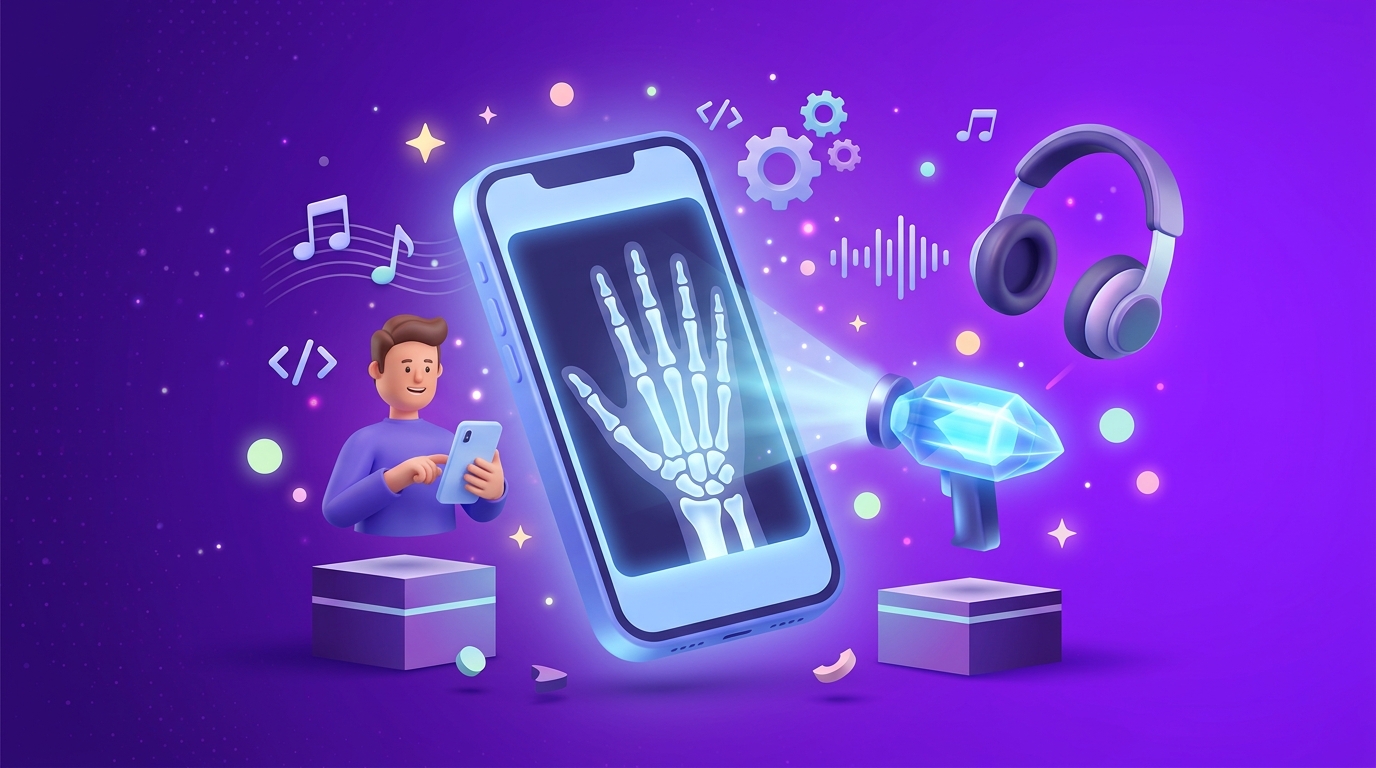
Let's get straight to the answer: no cell phone can actually take X-rays. None of the apps on this list emit radiation, take X-rays, perform tests, measure anything in your body, or give diagnoses. What exists are two very different things: play simulators, who draw a skeleton over the camera image just for fun, and DICOM file readers, These apps simply display on the screen an exam that has already been done by a real machine in a clinic. X-rays can only be done with medical equipment and by a qualified professional.
Having made that point, it's worth understanding why this question arises so often. The curiosity about "“take an x-ray The term "on mobile" is huge, and the app store is full of programs that exploit exactly that imagery. In this article, we explain how each type works internally, what they actually deliver, and how to use each one without confusion.
Unveiling the mysteries of X-rays in the mobile digital environment.
First and foremost, it's crucial to clarify that no smartphone has the physical capacity to emit ionizing radiation to capture real medical images. Therefore, when we talk about taking X-rays on a cell phone, we are referring to entertainment visual simulators and existing exam viewers. These tools only use a standard camera and pre-designed graphic images to recreate a visual effect.
On the other hand, the digital format has changed the logistics of imaging exams in recent years. Today, it's common for clinics to deliver the exam as a file instead of a film, and for the patient to save this file on their cell phone to take to the appointment. This is transporting a document, not performing an exam: the interpretation and conclusion remain the doctor's job. Thus, the tools are divided between the pure fun of simulating images and the convenience of carrying the actual exam in one's pocket.
5 tools related to X-rays that you can try.
1. Xray Body Scanner Camera (simulator)
This prank app stands out as one of the most fun options available to users on the Play Store today. Firstly, it uses your smartphone's camera to draw a digital overlay of bones on the screen in real time. Furthermore, the software simulates scanning specific body parts quickly. You can use this tool to play fun pranks on your friends, always making it clear afterwards that the image is a graphic effect.
In this way, the tool offers a very intuitive and easy-to-use interface for people of all ages. Certainly, the biggest attraction of this simulator is the speed of response of the visual effects presented on the screen. If you want to have fun simulating an X-ray on your cell phone, you can download the app right now for free. Just download it from the official store and start exploring the anatomical filters it offers for free.
2. XrayOn: Body Scanner Simulator (simulator)
This fun alternative simulates bones on your phone screen using a well-developed graphic animation created by the software's developers. Right after starting the program, you choose which body part you want to "scan" to begin the interactive game. Additionally, the system uses motion sensors to move the bone image as you move the device. Because of this, the visual effect is quite convincing at first glance—so always warn that it's a prank.
Therefore, if you're looking for a way to simulate an X-ray on your cell phone to entertain the family, this option does the job well. Downloading the app is simple and quick from your operating system's official app store. Furthermore, it consumes little internal memory, making it ideal for devices with less storage capacity. It's a lightweight simulator that usually generates good laughs among friends and family.
3. X-ray - Radiology Positioning (study material)
Unlike toy simulators, this app is a reference material on radiological positioning, a subject studied in radiology courses. It doesn't scan anyone and doesn't generate any images: it shows illustrations and texts explaining how each incidence is described in textbooks. In practice, it functions as an illustrated classroom summary that fits in your pocket.
The content is for theoretical reference only and is not intended to evaluate patient examinations, draw conclusions about any real case, or replace official course material or instructor guidance. If your interest is in understanding the terminology behind radiographs, it provides an introductory overview of the vocabulary in the field. To check it out, simply open the app's page in the official store.

You will see a short advertisement.
4. Xray Body Scanner Prank Camera (simulator)
This application has established itself as a good humorous X-ray simulator for current mobile devices. Firstly, the system uses high-definition pre-rendered images that align with the capture from your camera. The effect is convincing at first glance, and precisely for this reason, the recommendation is always to reveal the joke afterward: nothing there is an image of anyone's body, and the phone doesn't emit any waves.
Another positive point is that the utility receives updates to improve compatibility with new smartphone models on the market. As a result, the light and shadow effects in the drawn images become increasingly detailed. You can download this tool for free today to test the hand and foot animations. Download it from the official app store and have fun with this visual effect.
5. IDV – IMAIOS DICOM Viewer (existing exam reader)
This utility is used for open on screen an exam that has already been done In a clinic or hospital. In fact, it supports files in DICOM format, which is the standard used by diagnostic imaging services when delivering the exam as a file instead of a film. Therefore, it doesn't take X-rays: it displays the one you already have. Features like zoom and contrast adjustment are for better viewing the image on the small screen, not for drawing conclusions about it.
In this sense, the app functions as a digital exam folder: you save the file and show it at the appointment, instead of carrying an envelope. No measurement, filter, or annotation made in the app has clinical value., And none of this replaces the radiologist's report or your doctor's evaluation. If you have any questions about the result, it is the healthcare professional who interprets it. To check the official report, just open the app on the Play Store.

You will see a short advertisement.
Why do so many people look for this type of app?
✓ Creative games with friends and family
Camera simulators provide fun moments, allowing you to create pranks with images of bones drawn over the device's screen.
✓ Fun facts about the human body presented in a playful way.
The animations spark interest in anatomy in anyone who is curious, without any technical pretensions: they are generic illustrations, the same for anyone pointed at by the camera.
✓ Bring your own test results to the appointment.
DICOM readers allow you to save your past exams on your mobile phone to show your doctor during your appointment. It's always the doctor who interprets the images.
✓ Less paper and less paper to carry.
Replacing old envelopes containing X-ray films with lightweight digital files on a smartphone makes transportation easier and reduces the risk of losing the material.
What do you gain by using these solutions in your daily life?
Firstly, using file readers brings practicality to organizing your personal medical history. In the past, you had to carry large black envelopes with X-ray plates to every specialist appointment. Today, by storing digital files on your cell phone, this information is always at hand — remembering that storing and displaying is different from examining, and the reading remains the responsibility of the doctor.
Furthermore, the playful aspect of these platforms is welcome for curious young people who enjoy the topic. Through the animations, it's possible to talk about skeletons and the human body in a relaxed way, using the app as a starting point—and not as a source of anatomical information, since the images are generic drawings and don't represent anyone.
Finally, we cannot forget the recreational value that simulator apps bring to leisure time. They break the ice in meetings and entertain children and adults with eye-catching visual effects. In this way, you have both a game and a digital folder for your health documents on your phone.
Find the right option for your goal.
To choose the best program, first identify whether your goal is entertainment or simply viewing an exam file you already have. If you want to play with children and friends, simulators with fun filters will do the trick. If what you need is to open a DICOM file provided by the clinic, then an exam reader is the way to go.
Another important point is the available storage space on your device before downloading. Some simulators contain heavy graphics that may cause older devices or those with little RAM to crash. Therefore, read the technical specifications in the app store before starting the installation of your chosen software.
Finally, check the developer's reputation and user reviews on the store's own listing. This reduces the chance of downloading fake programs or those that display excessive ads. Always install from your device's official store, never from individual files sent by third parties.
Use safely and without misunderstandings.
When using apps that simulate X-rays on your phone, opt for well-lit environments for a better effect. Since most simulators rely on the rear camera, natural light helps the sensor identify the body's contours. This way, the alignment of the drawn bones will appear more aligned on the device's screen.
Furthermore, always remember to explain to people that the simulator is just a recreational tool for humor — the joke is only funny when it ends with the revelation. Never use these apps to try to assess pain, fractures, pregnancy, or any other health issue: they measure absolutely nothing. In case of an accident or suspected fracture, seek immediate emergency room care for qualified professional treatment.
Answers you were looking for about smartphone exams
❓ Is it possible to actually take X-rays with a cell phone to detect fractures?
No. Cell phones do not emit radiation and do not take X-rays. The apps are only for fun simulations or to display legitimate medical exams already performed in clinics.
❓ Do simulation apps charge any fees to be used?
Most of the listed options can be downloaded for free from the Play Store. However, some software may display ads or offer additional in-app purchases.
❓ How do I open the exam my doctor sent on my phone?
You must install a DICOM file reader app or open the secure link sent by the lab directly in your mobile browser. The app only displays the image; the interpretation is up to your doctor.
❓ Does this type of simulation app pose a risk to my health?
No, because they only use a regular camera and graphic images on the screen. There is no radiation emission of any kind.
❓ Can I use these apps on tablets?
Yes, most programs work on Android tablets, even offering a better viewing experience due to the larger screen size.
Summary: Is it worth testing these mobile technologies?
In short, the search for "taking an X-ray on your cell phone" shows how fascinated people are by technology and anatomy — but the technical answer remains the same: cell phones don't perform X-rays. Simulators serve their purpose well for entertainment, as long as the joke is revealed. And DICOM readers offer real convenience for those who need to carry their own X-rays.
Therefore, choose the option that matches your goal and download it from the official store. For laughs with friends, stick with simulators; for organizing your health documents, use an exam reader. And, for any medical issue, always consult a healthcare professional.