
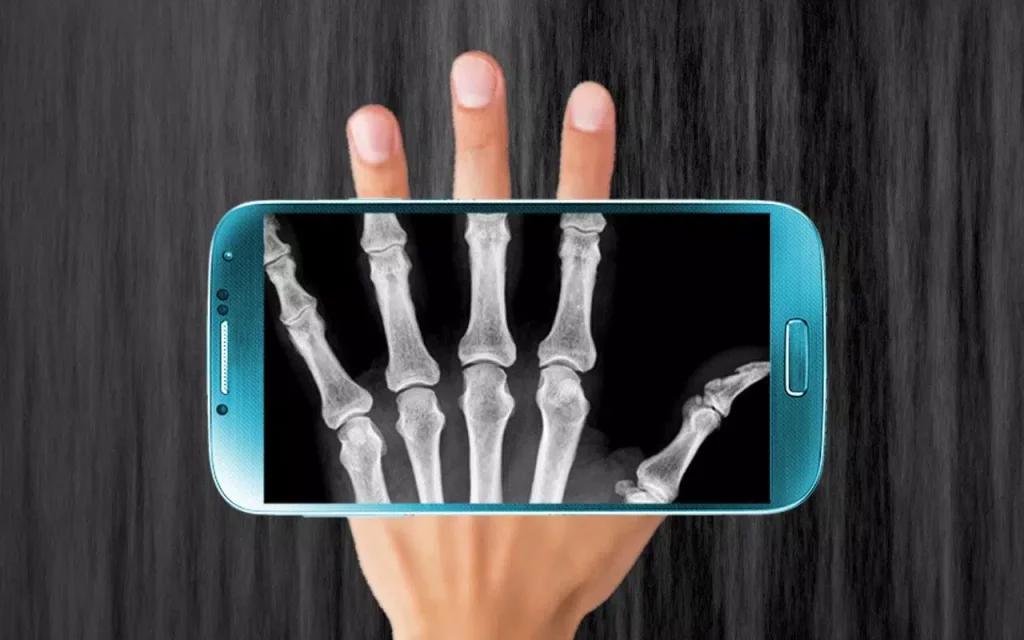
Smartphone technology is constantly advancing, bringing new and exciting features to our daily lives. One of them is the ability to... simulate An X-ray via cell phone. Let's make it clear from the start: no cell phone emits radiation or takes real X-rays. These apps are just for fun — they don't perform exams, measure anything, or diagnose anything — but they offer a fun way to create X-ray-style images.
With the rise of free X-ray apps, it's now possible to generate X-ray-style images of objects and body parts directly on your phone screen. These apps use pre-designed graphics and augmented reality to create stunning simulations, providing entertainment and a new form of interactivity.
The best apps that simulate X-rays on your cell phone.
These apps combine animation and humor. They allow you to surprise your friends with images that resemble X-rays, making any get-together more fun — and the fun is in revealing the prank right afterward.
Xray Body Scanner Prank Camera
The Xray Body Scanner Prank Camera offers a fun and interactive experience for simulating X-rays. With a simple and intuitive interface, the app allows you to choose different body parts for an X-ray-style "analysis." Ideal for surprising friends and family, it's a fun way to incorporate technology into your pranks.

Xray Body Scanner Prank Camera
Note: See the Play Store
Downloads: See it on the Play Store
Size: varies depending on the device.
Price: Free
Platform: Android
Body CamScanner Xray
The Body CamScanner Xray displays illustrations of the human skeleton in an X-ray style. The images are generic drawings, identical for any person pointed at by the camera, and are for entertainment purposes only: they do not represent anyone's body and have no educational or clinical value.
Real New Body Scanner
This app provides a quick and funny X-ray simulation. With simple questions, Real New Body Scanner generates surprising images that can be shared with friends. It's a great way to have a laugh with a fictional version of the "inside" of the body.
Full Body Scanner
The Full Body Scanner lets you simulate a complete X-ray experience. By pointing your phone's camera at different parts of your body, it overlays pre-made images on the screen. It's a great way to entertain friends and family at parties or gatherings.
Parasites Xray Scanner Prank
The Parasites Xray Scanner Prank takes simulation to a new level, creating images of fictional parasites on the body. Perfect for playing pranks and causing fun scares, this app blends humor and animation in a unique way. Since the effect can be frightening, quickly warn that it's a joke.
Common questions
Q: Are x-ray apps real? A: No. All of these apps are simulations made for entertainment purposes and should not be used for medical diagnoses. The cell phone does not emit radiation.
Q: Can I use these apps to learn about anatomy? A: No. The images are generic illustrations and do not correspond to anyone's body. To study anatomy, use real educational materials.
Q: Are these apps safe to play with children? A: Yes, they are harmless and can be a fun way to entertain children, but it's important to supervise their use and explain that they are just simulations.
Conclusion
Apps that simulate X-rays on your phone offer a fun way to play with technology. Since they're purely for entertainment, the best use is the simplest: play a prank and reveal the joke afterward. With a download from the official store, you can transform your smartphone into a generator of fictional images and share fun moments with friends and family. For any health concerns, consult a professional.
What to look for before installing
- Export for the doctor. A report in PDF or spreadsheet format makes the consultation much more productive.
- What the app actually does. Recording information is different from measuring. Health apps organize data that you or a device provide.
- What happens to your data?. Health data is sensitive. Check if it's being shared with third parties and if it's possible to delete everything.
- Integration with certified device. When there is a real measurement, it comes from equipment with a sanitary registration — the app only receives the number.
The limits: what no app does
Before installing, it's worth managing your expectations: there are things that no app in this category delivers.
- They don't provide diagnoses. No app can replace a professional evaluation.
- The cell phone does not measure blood pressure, glucose, body temperature, nor does it perform imaging tests. There is no sensor for that in the device.
- Estimates of steps, calories, and sleep are approximations based on motion sensors, with a significant margin of error.
- They are not a substitute for prescribed medication or treatment, and should not be used to guide dose changes.
Step-by-step to get started
- Write down the value along with the time. Date and time transform random numbers into useful historical data for the professional.
- Generate the report before the query. Exporting as a PDF and having it printed or on your phone greatly shortens the conversation.
- Check out the privacy policy. Health data is sensitive data. Check if it is being shared with third parties and if it's possible to delete everything.
- Use certified equipment when taking measurements. The cell phone doesn't measure; the equipment with sanitary registration does the measuring. The app only stores the number.
Traps that catch almost everyone
- Install an app that promises to detect disease through photos, sounds, or questionnaires.
- Swap in-person consultations for apps — none of them provide diagnoses.
- Believing that a cell phone measures blood pressure, glucose, or body temperature is wrong; there is no sensor for that in the device.
- Changing medication dosage based on a number seen in the app.
What the cell phone itself already does.
Android and iPhone already come with a native health app that consolidates steps, sleep, and measurements sent by other devices, with privacy controls by data type. It's usually the safest place to store your history, and you can export it to take to your doctor.
Physics explains why it's impossible.
It's important to understand the mechanism, because once you understand it, nobody else will fall for the promise.
An X-ray image requires three elements, and none of them exist in a cell phone:
- A source of ionizing radiation. X-rays are produced in a tube where electrons are accelerated by tens of thousands of volts and then abruptly braked against a metallic target. This requires high voltage, shielding, and cooling. A cell phone operates on a battery with only a few volts.
- An object located between the source and the detector. The image is formed because different tissues absorb radiation to varying degrees. It's transmission radiography: the source is on one side, the detector on the other. The person needs to be in the middle.
- A detector sensitive to this range. A cell phone sensor is designed for visible light, with filters that block out the rest. It does not record X-rays.
Therefore, the conclusion is categorical: there is no application capable of taking X-rays, seeing through walls, clothes, or bodies. What these programs do is overlay a generic image of a skeleton onto the photo, like an animated sticker. It's a joke, and that's how they should be presented.
What does a cell phone capture beyond visible light?
There is a real, albeit small, potential, and it often surprises—without promising anything magical.
Camera sensors are naturally sensitive to near-infrared, a range just above visible red. Manufacturers install a filter to block it because it would distort colors. This filter is usually more effective on the rear camera than on the front camera.
Hence the classic experiment: point a remote control at the phone's front camera and press a button. On many devices, a purple or white light appears on the screen that you can't see with the naked eye. That's the remote's infrared LED. It serves to test if the remote is working—and it's the limit of what the camera sees outside of what's visible.
What this does not allow:
- Seeing through fabric. Regular clothing blocks near-infrared radiation just as it blocks light.
- Seeing in the dark. Without an infrared source illuminating the scene, there is nothing to capture.
- See heat. Thermal imaging works with far-infrared, a completely different range that requires a specific sensor. There are thermal camera accessories that attach to cell phones, and they are expensive precisely because the sensor is different.
Imaging exam: who can have it and why?
Ionizing radiation poses a known biological risk, and therefore its use is regulated in Brazil. Diagnostic X-ray equipment is subject to specific health regulations, including requirements for service licensing, equipment quality control, room shielding, worker dosimetry, and procedures performed by qualified professionals under technical responsibility.
There are also international principles of radiological protection that guide the practice: the examination must be justified, that is, it must bring greater benefit than risk, and the dose must be the lowest possible to obtain the necessary information. This is why radiography is not done "out of curiosity" nor repeated without reason, and why there are specific precautions for pregnant women and children.
The practical consequence for the reader: imaging exams are requested by a healthcare professional and performed in a licensed facility. There is no home alternative, and no app, sensor, or cell phone accessory can replace this. The same warning applies to other similar promises circulating in app stores: the cell phone does not measure blood pressure, glucose, ultrasound, or pregnancy tests. There is no sensor in the device capable of any of these functions.
Using playfulness without creating problems
As a prank, these apps are harmless — as long as the image is presented as such. Two limitations deserve attention.
Never suggest that the image reveals someone's body. Producing or disseminating manipulated intimate content using a person's face or body is a crime under Article 216-B of the Penal Code, as amended by Law 13.772/2018. The fact that the content is false does not negate the offense—the law covers manipulated content.
Use with caution in a healthcare setting. Showing a simulated image and suggesting that it represents someone's examination, even jokingly, can lead to misinterpretation and, in a professional context, serious consequences. It is also not material to publish about third parties: a person's image is protected by Article 20 of the Civil Code, which prohibits disclosure that harms their honor or reputation.
The rule that works: the joke must be played with the person present, who knows about it and agrees, in a closed group. Otherwise, the risk isn't worth the laughs.
Permissions and scams in this category
"Special camera" apps are among the most problematic in app stores, precisely because their appeal attracts downloads, and nobody checks what they ask for. What to check before installing:
- Incompatible permissions. A camera effects app needs a camera and access to photos. Requests for contacts, SMS, call logs, precise location, or access to accessibility services are completely unjustified—and the latter gives broad control over the device.
- Installation outside of the official store. Individual files promising a "version that actually works" are one of the most common vectors for malware on Android.
- Recurring subscription For a visual effect. Weekly billing is the preferred model for this category, and cancellation is done in the store, not within the app.
- Out-of-control advertising. Full-screen ads appearing on every tap, promotional notifications, and automatic browser opening indicate an app designed solely to monetize traffic.
- Sending photos to the server. Test with airplane mode: if the effect works offline, the processing is local. If it doesn't work, your image is being sent somewhere.
- Developer's name. Clones copy the icon and title; the account that publishes it is different.
When uninstalling, remember to revoke permissions and check the list of active subscriptions in the store. Many mysterious charges on your bill come from apps installed out of curiosity and opened twice.