Instagram is one of the most popular social media platforms in the world, with over a billion monthly active users. One of Instagram's most popular features is its direct messaging function, which allows users to send private messages to friends, family, and co-workers.
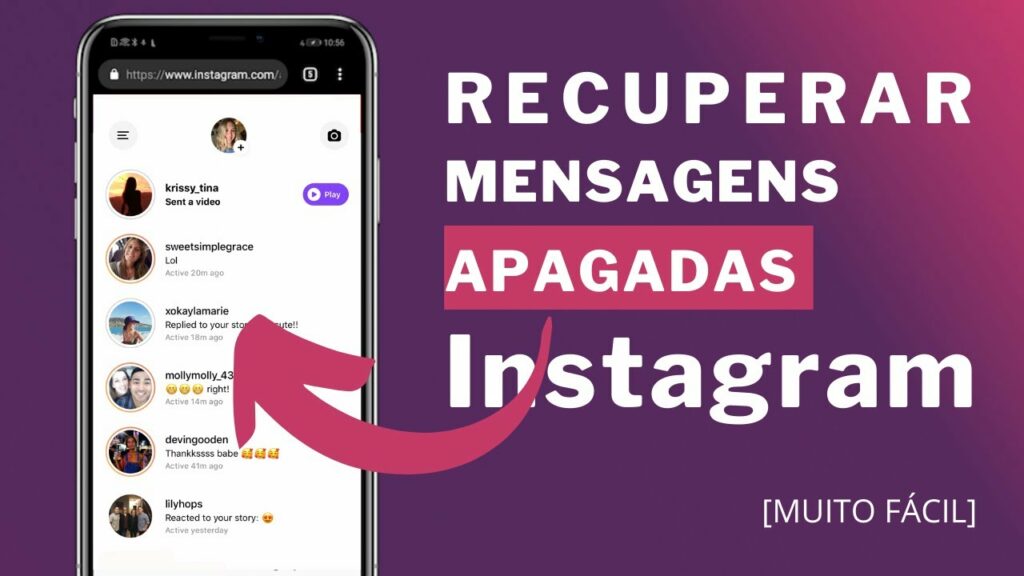
However, just like any other platform, messages can be deleted accidentally or intentionally. If you've ever lost an important Instagram message, don't worry, there are ways to get them back. In this article, we will teach you how to recover deleted Instagram messages.
How to recover deleted Instagram messages
- Access your profile and click on the drop-down menu to access “Settings”;
- Then tap “Security”;
- In the “Data and history” tab, tap “Download data”;
- Choose the email to which you want to receive the file and tap “Request download”;
- Enter your password and that's it, the request is made.
It is worth remembering that the process is not automatic and can take up to 48 hours for the user to receive the recovered messages in their email. If you don't find them in your main box, it's important to check your spam folder to get them.
I received the deleted messages by email. How do I open these messages?
When you receive the link to download your information from Instagram, it is important to remember that it expires within 4 days. Therefore, make sure to download the file within this period so you don't have to repeat the process.
Furthermore, it is recommended to download the file to your computer, as the information is received in HTML and can be easily accessed directly through the browser. Check out the step-by-step guide below to access your Instagram information and messages.
- Once you receive the link to download your Instagram information, make sure you open it within 4 days as the link expires after this time and the process needs to be repeated.
- Download the information to your computer, as the file is received in HTML and is easier to access directly through the browser.
- Access your email inbox and click “Download information”.
- You will be redirected to a new page where you must enter your username and password.
- Click “Download information” and wait for the download to complete.
- Open the “Downloads” folder on your computer and unzip the zipped file.
- When you access the folder, locate the “Messages” file and open it.
- Choose the conversation you want to recover and double-click to open it in your browser.
- Ready! Now you know how to download and access your Instagram messages from the downloaded information file.
Veja também:
Conclusion
In conclusion, deleting important messages from Instagram can be a frustrating situation. However, there are several ways to recover it, including the option of downloading your information from Instagram or using a third-party app.
Always remember to regularly back up your important messages as it can save you time and frustration in the future.
Additionally, it is important to be careful when downloading third-party applications as they may pose a security risk to your device and personal information. Ultimately, it is critical to be aware of the options available to recover your lost messages and take preventive measures to avoid future losses.
Deleted for you or deleted for everyone.
Before attempting any recovery method, it's necessary to know exactly what happened to the message. Different situations lead to different outcomes.
- Erased just for you. The message disappears from your screen and remains on the other person's device. Retrieving it on your end is unlikely, but the content exists on the other side.
- A disappointment for everyone. Some of the two screens. This is the option the sender uses to retrieve what they sent.
- Conversation archived or moved to requests. It wasn't deleted. It's in another tab. Many people try to recover the conversation when it's simply moved to a different location.
- Temporary message. Sent in a self-destruct mode after viewing, by design. No recovery is planned.
- Account blocked, deactivated, or deleted by the other party. The conversation disappears from your list without anyone deleting anything.
Identifying the problem saves time and avoids falling for promises of impossible recoveries.
Download your data: the official way
There is a legitimate feature, offered by the platform itself, and it is the only real way to access your history. It's called a request to download your information and it's located in your account settings, under privacy or account center.
How it works in practice:
- You request a copy of your data and choose the format — HTML, which is easier to read, or JSON, which is better for processing.
- The platform prepares the package and sends a link via email. This can take anywhere from a few hours to a few days.
- The file includes messages, photos, videos, comments, likes, login history, profile information, and advertising data associated with you.
- The link is only valid for a short time. Download it as soon as it arrives.
What to expect: the package includes what the platform still keeps associated with your account. Messages undone for everyone usually don't appear. Old conversations that remained in the account do. For those who only want to recover an address, an agreed-upon amount, or information shared in a conversation months ago, this method usually solves the problem.
This right is not a courtesy: the General Data Protection Law guarantees the data subject the right to access and transfer their data, and platforms implement this precisely through these export tools.
Why "message recovery" apps are a scam.
The pursuit of debt recovery has created an entire market for fraud, and the modus operandi is always the same. It's worth understanding why this promise is technically impossible.
The messages are stored on the platform's servers, protected by authentication. No external developer has access to third-party message databases. The public interface available to developers does not allow reading other people's private conversations, much less deleted content. Therefore, any application that promises this cannot be doing what it claims.
What these services actually do:
- They ask for your username and password. On a screen identical to the official one, you hand over the bill.
- They are asking for the two-step verification code., completing the robbery.
- They charge a recurring subscription fee. for a service that delivers nothing.
- They install monitoring software. on the device.
- They display a flood of ads. and they sell your data.
If you've already shared your password on one of these services: change your password immediately, enable two-step verification, review your active sessions, and remove any apps with authorized access to your account. And check if the registered email address is still yours—changing your email is the first thing an attacker does.
Monitoring someone else's conversation is a crime.
Much of the demand for these tools stems from distrust in relationships. It's worth being upfront about what Brazilian law says.
Accessing someone else's device without authorization, to obtain data or install monitoring software, is a crime under Article 154-A of the Penal Code, with increased penalties when it involves the content of private communications. This applies to spouses, partners, adult children, and anyone else. Knowing the password does not constitute authorization.
Disclosing private content obtained in this way aggravates the situation, and intimate images disclosed without consent have their own specific legal classification. In addition to the criminal risk, evidence obtained illegally is usually rejected in court, which negates even the supposed objective.
One notable exception is the supervision of minor children by their guardians, and even then, experts recommend using transparent parental control tools, with the teenager's knowledge, instead of hidden monitoring.
Preserve conversations that you'll need later.
If the conversation matters—negotiation, work agreement, threat, collection—saving it beforehand is infinitely easier than retrieving it later.
- Full screenshots, Showing the profile name, date, and uncut message sequence. A screenshot of a single message has little value.
- Screen recording playing the entire conversation. It demonstrates continuity and is more difficult to dispute.
- Official data package Requested from the platform, which provides metadata and is more robust than screenshots.
- Notarial deed. For legal purposes, it is the strongest method: a notary accesses the content in your presence and draws up a document describing what they saw. It has legal validity and resolves any dispute about the authenticity of screenshots.
- Report on the platform In cases of threats, harassment, or fake profiles, keep a record of the incident report number.
- Police report when a crime has occurred, with the evidence already organized.
Finally, three preventative measures that apply to any account: a unique password, not repeated across other services; two-step verification via an authenticator app, which is more secure than SMS; and periodic review of active sessions and apps with access permissions. Most compromised accounts weren't actually hacked—they were presented on a fake screen.