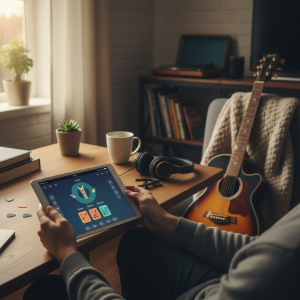
Music is a powerful form of expression and emotion, and finding new music that connects with us can be one of the most exciting things about listening to music.
However, with so much music available and so many artists releasing new work, it can be difficult to find new music that really speaks to you.
Fortunately, there are several music apps that offer music discovery features, allowing you to find new music similar to what you already like.
Spotify
One of the most popular apps for music discovery is Spotify. With its “Weekly discovery” function, the Spotify offers a personalized selection of new music based on music you already listen to.
Furthermore, the Spotify also offers themed playlists, like “New Music Friday,” which includes the latest releases from popular artists.
Pandora
Another popular app is Pandora. It uses artificial intelligence algorithms to suggest songs based on music you already listen to.
It also offers a “radio” functionality that creates a playlist based on a specific artist or song you like.
Soundcloud
The application Soundcloud It's also an excellent option for music discovery. It allows users to explore music from independent and lesser-known artists and offers recommendations based on your listening activity.
Shazam
The application Shazam is another option for music discovery. It allows you to identify songs playing live and offers recommendations for similar songs.
Last.fm
Finally, the music app Last.fm is an excellent choice of apps for discovering music. It uses your playback activity to create personalized recommendations and also lets you explore artists related to the ones you already listen to.
It also offers playlists and communities based on music genres and artists.
It is important to note that these apps are not the only options available for music discovery, and there are many other apps available on the market.
Additionally, many music streaming apps such as Apple Music and the YouTube Music, also offer music discovery features.
Conclusion
Music discovery apps are a great way to find new music similar to what you already like.
They use advanced algorithms and personalized recommendations to bring you new, exciting music that you might have missed.
If you're looking for a way to broaden your musical horizons and discover new artists, try some of these apps today.
What to look for before installing
- Data usage. Streaming in high quality consumes a lot of data. Adjusting the quality on your phone will prevent surprises when it reaches your data limit.
- Family or individual plan. Family plans typically start with two people and require a shared address for most services.
- It works on your device. Watches, cars, and speakers don't always have the app. It's worth checking beforehand if the service integrates with what you use.
- What the free version offers. Generally, it's ad-supported playback, shuffled order, and limited skips. Offline listening and track selection are usually paid services.
What these apps don't do
Before installing, it's worth managing your expectations: there are things that no app in this category delivers.
- Tracks are removed from the catalog when the license expires, including tracks from pre-made playlists.
- Lyrics and credits depend on what the record label sent and are sometimes incomplete.
- An app that offers paid content for free is piracy and often comes with intrusive advertising or malware.
- They don't allow downloading the music as a free file. The download is within the application and requires an active subscription.
Common questions
Can I listen for free?
It's possible, with advertising and some limitations, such as random order and a restricted number of jumps.
Does the quality change significantly between plans?
With regular headphones, the difference is minimal. With better equipment or a good speaker system, the difference becomes noticeable.
Can I transfer my playlists?
There are services that migrate playlists between platforms. The transfer usually works well, with occasional losses of unavailable tracks.
Can I listen without internet?
Only by downloading it within the app, which generally requires an active subscription.
Can I use it in the car?
Yes, via Bluetooth, or through Android Auto and CarPlay in compatible vehicles.
Step-by-step to get started
- Migrate your playlists when switching services. There are tools for transferring data between platforms; the loss is usually only due to unavailable tracks.
- Set up the equalizer once. Adjust according to the headphones you use — it's the cheapest way to improve sound quality.
- Download playlists via Wi-Fi. Get it ready before you leave. The download is within the app and depends on an active subscription.
- Reduce the quality of mobile data. In the settings, separate Wi-Fi quality from data quality. This cuts consumption in half.
Traps that catch almost everyone
- Listen in high quality using mobile data and exceed your data allowance.
- Installing an app that offers a paid catalog for free is piracy and usually comes with intrusive advertising.
- Signing up for the family plan without checking the requirement for a shared address.
- Losing created playlists when switching accounts instead of transferring them.
The alternative that is already included in the system
YouTube functions as a huge free catalog for discovering music, and streaming radio continues to exist within various free apps. For offline listening without a subscription, your own files still play in the system's native player.
How the service decides what to show you
Music recommendations aren't magic or a curator's personal taste. They're three combined techniques, and each has a blind spot.
- Collaborative filtering. The system observes that people who listen to A also listen to B and offers you B. It's the most accurate and effective technique: popular artists are heard by everyone, while those with few listeners hardly circulate.
- Analysis of the audio itself. The program extracts characteristics from the recording—tempo, tonality, energy, vocal presence, timbre—and groups similar tracks together. This is what allows it to recommend a completely unknown artist with no history of listeners.
- Word processing. The system reads public reviews, lists, tags, and playlists to understand how people describe each artist. That's where curious categories like "Brazilian rock from the 90s for driving at night" come from.
Combined, these factors explain the most irritating behavior: playlists that keep repeating the same twenty artists. If you listen to a particular style a lot, collaborative filtering reinforces that pattern, and the system interprets what you already know as correct. The algorithm is conservative by design—recommending similar content is less likely to be wrong.
How to educate the algorithm instead of fighting with it.
Every service learns from what you do, but the weight of each action is quite different from what most people imagine:
- Jump in the first few seconds It's the strongest negative signal. It's worth more than any "dislike" button.
- Listen to the end and repeat. It's the strongest positive sign. Liking something is explicit data, but listening to it again carries more weight.
- Save to library It anchors the artist to their profile for a long time.
- Follow the artist It primarily influences releases and new products, but less so recommendations for new discoveries.
- Leave it playing while you sleep. Poisons the profile. Hours of passive listening count as preference.
Here are four useful practices. First: when you want to explore something outside your usual pattern, use the private or anonymous session, available on most services — it prevents an afternoon of children's music or party soundtracks from reshaping your recommendations for weeks. Second: create separate accounts or profiles for the residents of the house; a shared account is the number one cause of meaningless recommendations. Third: delete songs from your library that you saved years ago and no longer listen to. Fourth: subscribe to playlists curated by humans and independent radio stations — they don't go through the same mechanism and break the filter bubble.
Strategies that truly discover new music.
If the goal is to break out of a repetitive cycle, some approaches work better than pressing "discover":
- Follow the credits, not the artists. Every track has a producer, composer, bassist, mixing engineer. Several services show the full credits and allow you to browse through them. Following the producer of an album you love takes you to places that no automatic recommendation offers.
- Go for the collaborations. Collaborations and remixes connect entire scenes.
- Explore by label. Independent record labels have a distinct sound. Discovering the label behind a favorite album often leads to discovering dozens of artists.
- Listen to the entire album. Playlist logic rewards the hit track; the complete album showcases the true artist and feeds the algorithm with better signals.
- Use lists of festivals and public radio stations. The programming for a festival is curated by people who listen year-round.
- Look for covers and versions. A song you know, recorded by someone from another scene, is the most comfortable gateway to an unfamiliar style.
Your listening history is your data — use it and protect it.
The services record every track played, and this record has practical value. The annual reports that go viral on social media are the marketing version of something that could be better exploited.
What can be done with one's own history?
- Export your data. Almost every service allows you to request a complete copy of your transcript. It usually comes in a structured file, with the date and time of each copy.
- Migrate platforms without losing everything. There are tools for transferring playlists between services. Before authorizing, check what permissions the site requests — read access to the library is sufficient; permission to publish on your behalf is not.
- Record what you listen to across multiple apps. Scrobbling services aggregate listening data from different sources into a single, platform-independent history. It's the only way to avoid starting from scratch every time you switch services.
Regarding privacy, it's worth adjusting three things: whether your listening activity is public to followers, whether your profile appears in searches, and whether personalized advertising is active. Musical history reveals routine, mood, religion, and sleep schedule with surprising accuracy. This is not trivial information.
When the problem is not the algorithm.
Some behaviors are attributed to the recommendation, but have another cause:
- Artist who disappeared from the catalog. Licensing. Contracts between record labels and streaming platforms expire, and the work is removed from the air without notice. It has no relation to what you listen to.
- A different version from the one you were familiar with. Re-recordings, remasters, and regional editions coexist in the catalog. A search usually shows the most recent release.
- Music available in one country and not in another. Rights are territorial. Traveling changes what appears.
- Recommendation in another language. It usually comes from shared listening, a public playlist you followed, or the country set on your account.
- A track that plays muffled or at a different volume. It's volume normalization, an adjustment made by the app itself that equalizes the level between tracks. You can turn it off in the playback settings.
Understanding the origin of each behavior saves time searching for a button that would solve the problem — and shows where it's really worth making changes.