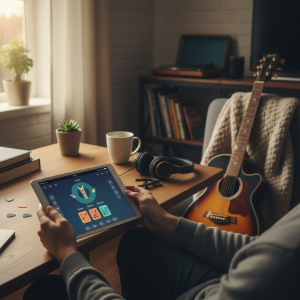
There is no doubt that music plays a crucial role in our everyday lives. It boosts our mood, relieves stress, and much more. With the digital age, music consumption has become easier than ever through streaming applications. However, these applications generally consume a significant amount of mobile data.
Therefore, the question that arises is: “How to listen to music without spending internet?” Fortunately, there are apps that allow you to download music for offline listening, saving your mobile data. This article explores some of the best apps for listening to music without spending internet.
The best music apps of 2021
Spotify
Spotify is, without a doubt, one of the most popular platforms for listening to music. Additionally, it offers the option to download music for offline listening. The option is only available to premium subscribers, but considering Spotify's vast music library, it's a worthwhile investment.
Apple Music
Apple Music is another robust option for music lovers. Similar to Spotify, Apple Music allows its users to download their favorite songs for offline listening. All you need is a paid subscription, but the service offers an extensive, high-quality music library.
YouTube Music
YouTube Music is a music streaming service that lets you download music for offline listening. With a premium subscription, you can enjoy your favorite music and videos without interruption from ads and, crucially, without wasting your internet.
Amazon Music
Amazon Music is a streaming service that also allows users to download music for offline listening. With an Amazon Music Unlimited subscription, you can access millions of songs, playlists, and radio stations ad-free.
Deezer
Last but not least, Deezer also offers an offline music listening experience. With a premium subscription, users can download their favorite songs, albums and playlists to listen to anytime, anywhere without having to worry about consuming mobile data.
Conclusion
In short, there are several options available to listen to music without spending mobile data. Whether with Spotify, Apple Music, YouTube Music, Amazon Music or Deezer, you can enjoy your favorite music anywhere, anytime, without having to worry about using mobile data.
Most of these services require a premium subscription to access the offline listening feature, but considering the convenience and data savings, it's a worthwhile investment. Music is an essential part of our lives, and these apps make it easy to enjoy it in a way that fits our digital lifestyle.
Criteria that make a difference in the choice
- Family or individual plan. Family plans typically start with two people and require a shared address for most services.
- Data usage. Streaming in high quality consumes a lot of data. Adjusting the quality on your phone will prevent surprises when it reaches your data limit.
- Audio quality available. The bit rate varies by plan. On standard headphones the difference is subtle; on better equipment, it's noticeable.
- Catalog in Portuguese and local format. International streaming services sometimes have glitches in sertanejo, forró, and gospel music. If that's what you listen to, test it before subscribing.
What these apps don't do
It's important to know what's beyond the reach of this category—that's what avoids frustration and, most importantly, prevents falling for those who promise the impossible.
- An app that offers paid content for free is piracy and often comes with intrusive advertising or malware.
- Losing your subscription means losing access to what you downloaded — it's not a purchase, it's a usage license.
- Lyrics and credits depend on what the record label sent and are sometimes incomplete.
- They don't allow downloading the music as a free file. The download is within the application and requires an active subscription.
Common questions
Can I transfer my playlists?
There are services that migrate playlists between platforms. The transfer usually works well, with occasional losses of unavailable tracks.
How much data does streaming use?
At high quality, it's around 100 to 150 MB per hour. Reducing the quality in the settings significantly lowers this number.
Can I listen without internet?
Only by downloading it within the app, which generally requires an active subscription.
Can I listen for free?
It's possible, with advertising and some limitations, such as random order and a restricted number of jumps.
Can I use it in the car?
Yes, via Bluetooth, or through Android Auto and CarPlay in compatible vehicles.
What to do, in order.
- Download playlists via Wi-Fi. Get it ready before you leave. The download is within the app and depends on an active subscription.
- Let the app learn. Liking and skipping are key to the recommendation. Two weeks of use significantly changes what appears.
- Set up the equalizer once. Adjust according to the headphones you use — it's the cheapest way to improve sound quality.
- Reduce the quality of mobile data. In the settings, separate Wi-Fi quality from data quality. This cuts consumption in half.
Where most people slip
- Signing up for the family plan without checking the requirement for a shared address.
- Cancel your subscription and lose access to all downloaded data.
- Installing an app that offers a paid catalog for free is piracy and usually comes with intrusive advertising.
- Losing created playlists when switching accounts instead of transferring them.
What the cell phone itself already does.
YouTube functions as a huge free catalog for discovering music, and streaming radio continues to exist within various free apps. For offline listening without a subscription, your own files still play in the system's native player.
The exact calculation: how many megabytes does each hour of music consume?
Music uses bandwidth proportional to the chosen quality. The calculation is straightforward: divide the bitrate by 8 to get kilobytes per second and multiply by 3,600. The practical results:
- 96 kbps (low quality): approximately 43 MB per hour.
- 128 kbps (normal quality): approximately 58 MB per hour.
- 160 kbps (average quality, standard for most): approximately 72 MB per hour.
- 320 kbps (high quality): approximately 144 MB per hour.
- No losses, FLAC type.From 400 MB to over 700 MB per hour.
With a 4 GB monthly data package, this means approximately 95 hours of music at 96 kbps, 56 hours at 160 kbps, or 28 hours at 320 kbps. Two hours a day in high quality will consume the entire data allowance before the end of the month.
Here's a detail that catches almost everyone off guard: listening to music on video platforms. Even with the screen off, many apps continue downloading the video stream. Data consumption jumps to 300 MB to 1 GB per hour—seven to twenty times more than the same audio on a music service. Switching sources is the easiest way to save money.
Download at home: what actually stays on the device
Offline downloads from streaming services don't create a regular music file. It's an encrypted file, associated with your account, that can only be played within that application. This has practical consequences:
- It can't be copied. to another cell phone, send by message, or put on a USB drive in the car.
- It needs periodic reconnection. Most services require the app to access the internet approximately every 30 days to renew its license. After that, downloaded content stops playing.
- Disappear if the subscription ends. The file remains on the device, taking up space, but it won't open.
- It's by device. Downloading on a mobile phone won't download on a tablet.
Music purchased from a digital store or ripped from a CD you own generates a free file that can be played on any application, is copyable, and does not expire. For those who spend a lot of time without internet access, this difference matters more than the price.
How much storage space does it occupy?
At 160 kbps, a four-minute track is around 4.6 MB. At 320 kbps, it's close to 9.2 MB.
- 100 songs in medium quality: approximately 460 MB.
- 500 songs in medium quality: approximately 2.3 GB.
- 500 songs in high quality: approximately 4.6 GB.
On a 64GB phone with photos and videos, the offline library is often the second biggest consumer of storage space, second only to the gallery. It's worth reviewing it from time to time and deleting playlists you no longer listen to.
Settings that solve everything at once.
Five adjustments, made only once, eliminate the problem forever:
- Separate quality for mobile data. Almost every music app lets you set one quality for Wi-Fi and another for mobile data. Set it high on Wi-Fi and low on mobile data.
- Download only via Wi-Fi. It prevents a new playlist from automatically syncing while you're out and about.
- Turn off aggressive pre-charging. Some services download recommended tracks in advance that you might not even listen to.
- System data economy. Android and iPhone have a mode that cuts data usage in the background. It's a safety net for apps that don't respect their own settings.
- Restrict background usage. From music apps you no longer use. Many of them sync their catalog and advertising even when closed.
After that, open the system's data usage dashboard and look at the consumption by application. It shows exactly who spent what in the cycle, and there's almost always a surprise on the list.
Internet radio, FM radio, and the difference that nobody notices.
There is a common confusion between "online radio" and the FM radio built into the device.
Internet radio is streaming like any other: it consumes data, generally between 40 and 130 MB per hour depending on the station's quality. The advantage is that it requires nothing more than an internet connection, and the catalog is worldwide.
Many Android devices already have a built-in FM receiver on the chip. When present, it picks up the signal wirelessly and doesn't consume any data—the wired headphones act as an antenna, which is why the feature only works when headphones are plugged in. It also consumes significantly less battery than streaming because it doesn't use the mobile network. Not every model has it, and several manufacturers have disabled the receiver via software, but it's worth checking the device before assuming it doesn't exist.
For those who spend hours in places without data signal — construction sites, fields, roads, underground — this is the only source of live music that continues to function.
Where the economy slips away without anyone noticing.
- Video advertisement. On the free plan, the video commercial consumes much more data than the music itself and also lights up the screen.
- High-resolution album cover. It may seem like a minor detail, but browsing through a large catalog loads hundreds of images. Some apps have an option to reduce this.
- Podcast and music video in the same account. A one-hour video episode can consume more than a week's worth of music.
- Automatic playback at the end of the playlist. The app plays recommended tracks indefinitely. If you fall asleep listening to them, it will play all night, consuming data. The shutdown timer solves this.
- Library synchronization across multiple devices. Cell phones and tablets downloading the same playlists double consumption.
- Shared cellular router. If someone uses your hotspot, the other person's music streaming counts against your data allowance.
One last habit that often yields more results than all the adjustments combined: keep a fixed folder with the 200 or 300 tracks you actually listen to repeatedly, downloaded over Wi-Fi, and leave the discovery of new music for when you're connected at home. Most data consumption with music comes from browsing catalogs, not from listening to what you already know.