
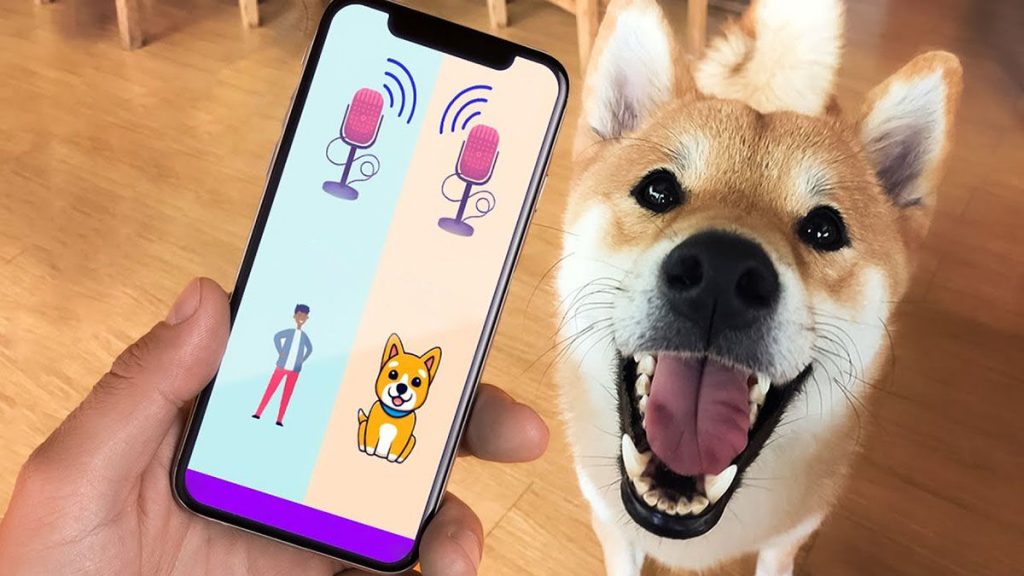
Important warning before anything else: there is no real translation for "latido" (bark). No app can convert the sounds your dog makes into meaningful sentences because dogs don't use a language with words and grammar. So-called "bark translators" are... games and entertainment simulatorsThey capture the audio, apply an effect, and return a phrase chosen from a pre-selected list. It's fun, but it has no scientific value and is not useful for assessing the animal's health.
That said, curiosity about what your dog wants to communicate is legitimate — and there are methods that actually work. In this guide, we've separated two things: "translation" apps that are fun and serious apps that truly help with coexistence, such as positive reinforcement training, monitoring your pet at home, and breed identification. All are available in official app stores and can be installed via Google Play.
Why is the translation of bark not possible?
Barking is a signal, not a word. It varies with breed, age, context, and even the history of each animal—the same sound can mean alert in one dog and a request to play in another. Furthermore, much of canine communication is non-auditory: it happens through posture, tail and ear position, eye contact, and body language.
Therefore, an app that only listens to audio, without seeing the animal's body or knowing the situation, cannot reach a reliable conclusion. The person who consistently interprets the dog is you, the owner, through daily observation—and, when there is doubt about behavior or suspicion of pain, a veterinarian or a qualified trainer. No app replaces this assessment.
"Bark translation" apps: entertainment
Tradutor humano para cachorro
This is the most common format in the category, and the developer himself describes the app as a simulator and a game. You record a bark or speak a phrase, and the app returns a funny sound or caption. The response is generated from a fixed repertoire, meaning there is no real analysis of what the animal intended to say.
It's great for having fun with the family and making videos, and the app is free with ads. Just don't use the results to make decisions about your dog's well-being. If the animal barks differently than usual, persistently, or accompanied by trembling and lack of appetite, the best course of action is to consult a veterinarian, not your phone.

Dog Whistle (apito de alta frequência)
Instead of “translate”, the Dog Whistle It does the opposite: it transforms the cell phone into a whistle that emits high-frequency sounds, in the range that dogs perceive better than we do. It's an auxiliary training tool, used to get the animal's attention during command training.
It should be used in moderation and always in conjunction with positive reinforcement, never as punishment or to irritate the animal. The loud and repetitive sound can cause discomfort, and the effect varies greatly from dog to dog. If the goal is to correct a persistent behavior, a professional trainer will provide better guidance than any app.

Apps that truly help with communication with your dog.
Woofz
O Woofz It's a dog training app that organizes command routines into short lessons, with explanatory videos and plans by age and goal. It doesn't interpret barks; it teaches you to communicate with your dog in a way the animal understands, using positive reinforcement and repetition.
There's a free version and subscription-based features. The big advantage is the tracking: the app records the progress of each command, which helps maintain consistency — the factor that most influences the outcome of any workout.

Dogo
O Dogo It follows the same lines as guided training, with an extensive library of commands and tricks, an integrated clicker, and a dog diary. In some plans, it's possible to send training videos and receive feedback from trainers.
It's a good choice for those who have just adopted a puppy and want a clear sequence of what to teach first. The diary is also useful during veterinary consultations: recording episodes of excessive barking, fear, or agitation, with date and context, helps the professional much more than an automatic "translation.".

Dog Monitor
O Dog Monitor He uses two of his own devices: one stays at home as a camera and microphone, and the other receives the image and audio. When the dog barks, you receive an alert and can talk to him remotely. It's the most direct way to find out what happens when you leave—whether the barking is a reaction to external noise, separation anxiety, or boredom.
It's worth reiterating: the monitoring is done by their own environment and that of their own animal., With devices that belong to you, cameras should be placed in common areas of the house and never in other people's private spaces. With this precaution, the app becomes an honest observation tool, much more informative than any translator. Unlike the others on this list, it is a paid app: the price appears on the Google Play listing before installation.

Dog Scanner
O Dog Scanner It identifies the likely breed from a photo and provides a profile with typical temperament, energy, and exercise needs. The result is an estimate, not a definitive diagnosis—in mixed-breed dogs, identification is approximate by nature.
Still, it helps to understand the context. Breeds bred for herding or guarding tend to vocalize more, and knowing this changes how you interpret the behavior: instead of looking for a "translation," you start to interpret the bark within the animal's profile.

How to interpret a bark without an app.
The most reliable interpretation comes from the combination of sound, body language, and context. Short, high-pitched barks in sequence usually appear in situations of excitement and an invitation to play. Deep, spaced-out barks are more common in alert situations and when defending territory. Whining and howling are frequently associated with discomfort, loneliness, or a need for attention.
None of this is a fixed rule, and that's where observation comes in: note when it happens, what was happening around it, and what made the behavior stop. In a few weeks, this record says much more about your dog than any phrase generated by an app. Abrupt changes in pattern—a calm dog that starts barking incessantly, or a communicative dog that becomes silent—deserve veterinary evaluation.
FAQ
Q: Are bark translation apps accurate? A: No. They don't analyze meaning; they return phrases from a pre-prepared list. They are entertainment products and should be viewed as a game.
Q: Is there any technology that translates animals? A: There is academic research analyzing vocalization patterns of various species, but none of that has become a home-use translator. What reaches app stores is a simulation.
Q: So what really helps me understand my dog? A: Daily observation of behavior, training with positive reinforcement, an exercise routine appropriate to the breed, and veterinary follow-up. Training and pet monitoring apps support this process.
Q: Can I use these apps with any breed? A: Yes, both playful and training drills work with any dog. What changes is the pace of the training, which depends on the animal's age, temperament, and history.
Conclusion
The idea of translating barks is charming, and there's nothing wrong with having fun with apps that simulate it—as long as it's clear that it's just a game. The truly useful technology today lies elsewhere: in training apps that teach commands with positive reinforcement, in monitors that show what your dog does when left alone, and in tools that help you better understand your pet's personality.
Combine these tools with daily attention and, when something deviates from the norm, seek veterinary care. It is this mix of observation and professional guidance—not an automated caption on the screen—that builds a peaceful relationship with your dog.