To have fun, you should try the apps to simulate a beard. If you've dreamed of having a better beard or simply outlining the outline of it, you'll certainly be interested in these new apps.
Nowadays, looking good is in fashion and every gentleman strives to beautify his physical appearance. It should be noted that not all men like having a beard. Others, on the other hand, want to have it, but it doesn't grow or fit well on their face.
Therefore, to help you understand more about the apps to simulate a beard, I prepared today's article on the subject. Interested in finding out more? So follow me now!
What are the apps to simulate a beard?
Barba foto Editor
To show off the beard of your dreams, it will take a few months as it grows naturally and you begin to train it. With this tool, considered one of the most notable, you will get the look you want. It's a simple editor with clear images that are taken in real time.
It can be downloaded for free and is compatible with multiple devices. O Photo editor allows you to upload the photos to put your desired facial hair.
It also offers a wide variety of spectral tattoos that blend with the beard style.
Barba
It is an excellent quality simulator to add any type of beard to existing photos. It offers various types of beards and mustaches. Furthermore, the beard simulator features the possibility of adding attractive glasses to match the selected beard.
This application is very easy to use. You just need to select the photo to edit, choose the beard or mustache, paste it and adjust it to your liking. This action usually only lasts about 10 seconds. Photos can be shared through different social networks.
Beard Man
This is one of the best apps that have been made. It allows you to design the beard with a variety of facial hair according to the wearer's style and taste.
Any type of beard can be done as Beard photo editor works like a photo booth.
The photos coming out of this app are very stylish and instantly. It has the property of capturing popular selfies with clarity and color accuracy. The application checks the poses taken and blends the beard with luminosity and shine effects.
Barba Real
It's an application that combines the possibility of creating a beard style and haircut in a great way. It brings an additional editor to place colors in selected styles. It has a variety of lenses that can be placed on the photo directly without any problem.
It's free and easy to download. Once the desired look is achieved, the photo can be saved and shared via social media. Also, Real Beard has powerful camera with beauty effects with latest fashion designs.
Did you like to know more about the apps to simulate a beard? So be sure to follow the other articles on the blog, I have lots of other news for you!
See too:
Apps to make you look younger in photos
Have you ever imagined yourself bald? Discover the Apps that do this!
What to look for before installing
- Where do your images go?. Tools that use cloud processing upload the photo. Read the policy before sending an image of a document or a child.
- It works without internet. Editors who process photos on their own device work offline. Those that rely on a server do not—and send your photo externally.
- Resolution of the exported file. Some reduce the image size when exporting without a signature. If the photo is for printing, this is a crucial factor.
- Watermark on the free version. This is the most common trick: the app lets you edit for free, but then stamps the logo on it when you save. Check this before investing your time.
What these apps don't do
Before installing, it's worth managing your expectations: there are things that no app in this category delivers.
- Recovering deleted photos only works on images that haven't been overwritten yet, and the chances of success decrease with each use of the device.
- No app can see through clothes or walls. What exists is simulation — a generated image, not a captured image.
- They don't recover details that don't exist in the file. Increasing the resolution reconstructs pixels by estimation—it doesn't reveal lost information.
- They don't remove watermarks from third-party photos. Besides not working properly, using the image without a license is a copyright violation.
Common questions
Is a free editor safe?
Check the permissions requested. A photo editor does not need access to contacts, messages, or microphone.
Will my photos go to the cloud?
It depends on the app. Those that do everything on the device work offline; those that use a server send the image externally.
Can I edit without a watermark for free?
Yes, in several applications, but with limited features. Check beforehand by saving a test image.
Which format should I save it in?
JPEG for general use, PNG when there is transparency or text, and the original format when archiving.
Is it possible to recover a deleted photo?
If there's a backup in Google Photos or iCloud, yes. Without a backup, only if the space hasn't been overwritten—and that chance drops quickly.
Step-by-step to get started
- Save only once. Each export process recompresses the file. Make all the necessary adjustments and export at the end.
- Work on a copy. Duplicate the image before editing. Good apps do this automatically, but double-checking prevents losing the original.
- Adjust the light before applying the filter. Exposure, contrast, and shadows first; filter later. In reverse order, the filter amplifies the flaw.
- Crop with the purpose of taking into account where the photo will end up. Square and vertical 4:5 for social media, 16:9 for screen. Crop after exporting and recompress again.
Traps that catch almost everyone
- Send a photo of a document or a child to an editor who processes it in the cloud.
- Increasing the resolution in the hope of revealing detail — the program estimates pixels, it doesn't retrieve information.
- Granting access to all photos when the app only needs one.
- Saving after each adjustment and watching the image lose sharpness without understanding why.
The alternative that is already included in the system
The phone's built-in gallery editor already handles cropping, light adjustment, object removal, and perspective correction in recent versions of Android and iPhone. For quick adjustments, it solves the problem without installing anything or sending the image externally.
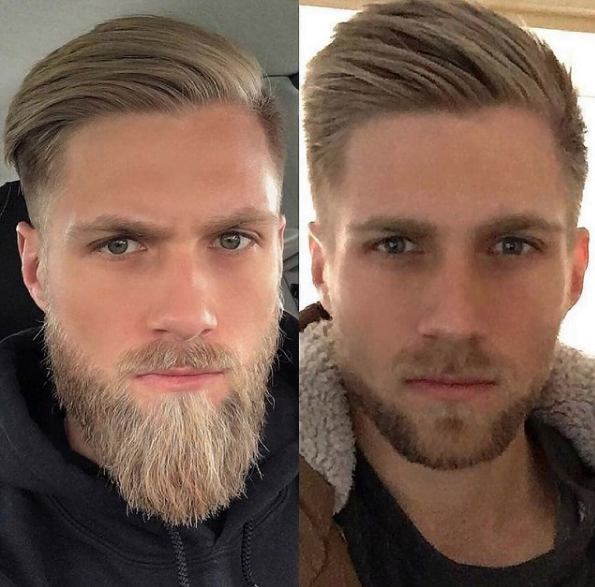
How the app decides where the beard touches.
The simulator doesn't randomly draw hair on top of your photo. It goes through three steps, and understanding this explains almost all the flaws that appear in the result.
First, the program locates reference points on the face: corners of the eyes, base of the nose, corners of the mouth, contour of the chin and jawline. Then, it distorts a ready-made beard template to fit these points. Finally, it blends the texture with your skin tone, adjusting transparency at the edges so it doesn't look like a sticky sticker.
Where this fails:
- Side view of the face. With the face turned too far, the points on one side are hidden. The program estimates the position and gets it wrong, leaving the beard outside the chin area.
- Open mouth or wide smile. The jaw shifts position and the model stretches in an odd way.
- A beard that already exists. The simulator overlays, it doesn't remove. Testing a short style over a long beard will give confusing results.
- Chin in shadow. The program interprets the shadow as volume and positions the edge incorrectly.
The ideal photo for simulation is simple: face straight on, mouth closed, light coming from the front, hair away from the jawline, no sunglasses, and with the neck visible. Five seconds of careful shooting are worth more than switching apps three times.
Choosing a style based on face shape
A beard changes the perception of facial shape because it alters the contour of the lower half. This is the logic that barbers have used for decades, and it works well as a filter even before opening the simulator:
- Round face. Fuller beards on the sides increase width. Shorter beards on the cheeks and some length on the chin visually lengthen the face.
- Elongated face. The opposite: length at the chin elongates the face even more. Thickness at the sides and a trimmed chin create balance.
- Square face with a defined jawline. Almost anything works. A short, even beard usually enhances the existing facial features.
- Poorly defined chin. A beard with concentrated density below the lip and on the chin creates the missing line.
Two technical decisions are just as important as style. The first is where the beard ends on the neck: the classic reference is an imaginary line above the Adam's apple, curving along the jawline — cutting close to the jawline makes the face look like a double chin. The second is the cheek line: keeping it natural is less aging than drawing a straight, high edge.
How long does it take in real life?
The simulator delivers the result in three seconds; the mirror does not. Knowing the timeframe prevents giving up in the third week, which is when almost everyone shaves everything off.
Facial hair grows an average of about 1.25 cm per month, with significant variation between individuals. This gives the following approximate references:
- Stubble, like three days' worth: three to five days.
- Short, even beard: Two to four weeks.
- Medium beard, already with a defined shape: Two to three months.
- Full, long beard: six months or more.
The most difficult phase is between the second and fourth week, when growth is uneven and itchy. The standard recommendation from barbers is not to trim anything during the first four weeks, precisely to discover where the beard actually grows before deciding on the shape.
One point that no app shows: hair density is genetic. Gaps in the cheeks won't be fixed by waiting longer. If the simulation shows a full beard and your face has hairless areas, the realistic style is different — a goatee, a mustache with a goatee, or a short, contoured beard usually look better than insisting on a full beard that just won't grow.
Why does the color never match on the first try?
Almost every complaint about beard simulators is about color. Three reasons explain this:
- The beard is rarely the same color as the hair. It's common for hair to appear more reddish or lighter, and it's common for gray hairs to appear years before the hair turns gray. The app often uses the correct hair tone and gets it wrong.
- The light in the photo distorts all the tones. Under a yellow light, the skin appears orange, and any applied beard looks reddish. Correcting the image temperature before the simulation solves the problem more than just adjusting the beard color.
- The screen is not neutral. Cell phones come from the factory with saturated color modes and the night light filter turned on by the hour. Evaluating color with this filter active leads to the wrong conclusion.
If the app allows it, manually adjust the color to be one shade lighter than your hair and reduce the saturation slightly. It will be closer to the real color than the automatic default.
From the simulator to the barber's chair.
The generated image has a much better use than just decorating social media: serving as a visual reference in the barbershop. A few precautions make the conversation more productive:
- Bring two or three images of the same style., and not just one. Different angles prevent misinterpretation.
- Speak in millimeters. Trimming machines work with numbered combs, and each number corresponds to a height. Asking for "number 2 on the sides, scissors on the chin" is more precise than any photo.
- Show me the neckline you want. This is the point where there is the most divergence of taste.
- Be realistic about the density. A good professional will tell you if that style works for your growth pattern. It's worth listening to them.
- Schedule maintenance. A well-defined beard loses its shape in two to three weeks. Without maintenance, any style will become stubble.
Between trims, the basics are enough: wash with water and mild soap, dry well, comb in the direction of growth, and trim only the hairs that stray from the desired shape. Itching in the first few weeks is normal and will pass; however, if there is flaking, persistent redness, or ingrown hairs with inflammation, the issue is no longer just cosmetic, and it's worth consulting a dermatologist.