With easy access to technology and the internet, planning a trip has never been so simple.
In addition to researching information about the destination, you can use apps to optimize your travel time and budget.
Here are five apps that can help you make the most of your vacation.
Google Maps
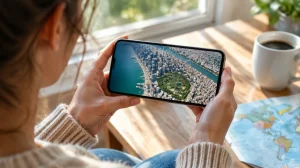
Google Maps is a free navigation app that offers maps from around the world, traffic information, directions and routes to reach your destination.
Additionally, you can search for tourist attractions, restaurants, hotels and other places near you.
With offline mode, you can download maps and use them without an internet connection.
Airbnb
Airbnb is a room and house rental platform that offers cheaper and more personalized accommodation options compared to traditional hotels.
Additionally, you can filter by location, price, type of accommodation and other criteria.
With the messaging function, you can contact hosts before booking and clarify any questions about the place.
Skyscanner
Skyscanner is a travel app that lets you search for flights, hotels and car rentals around the world.
You can filter by destination, date and budget, and compare prices to find the best options.
Additionally, you can set up price alerts to receive notifications about changes in the price of airline tickets.
Packpoint
Packpoint is a travel checklist app that helps you organize your needs according to destination, trip length, and planned activities.
Based on the information provided, the application suggests what to pack, such as clothes, hygiene items and medicines.
Additionally, you can customize the list and add extra items, such as documents or electronics.
XE Currency
XE Currency is a currency conversion app that allows you to convert over 180 currencies in real time.
It is useful for calculating the value of purchases, payments and budgets during your trip.
The app also offers historical exchange rates, price trend charts, and options to save favorite currencies.
Conclusion
Travel apps can be a great help in making your trip more efficient, organized and economical.
With Google Maps, you can access real-time navigation and route information.
Airbnb allows you to find cheaper and more personalized accommodation options. Skyscanner helps you compare prices for flights, hotels and car rentals.
Packpoint helps you organize your travel needs. And XE Currency allows you to convert currencies easily.
Choose the apps that best meet your needs and have an incredible trip.
Criteria that make a difference in the choice
- Where the reservation is recorded. Choose the one that sends email confirmation with a location code — you can access it even without the app.
- It works offline. Map, translator, and offline travel documents are saved when data routing fails abroad.
- Final price, including taxes. Always compare the total price. Service fees, baggage fees, and seat selection usually only appear at the end of the purchase process.
- Customer service in Portuguese. In case of problems, a platform without support in Portuguese and without a telephone channel becomes quite complicated.
What these apps don't do
It's important to know what's beyond the reach of this category—that's what avoids frustration and, most importantly, prevents falling for those who promise the impossible.
- Ticket prices change based on real-time availability; the price shown in the search may no longer be available at checkout.
- Offline maps become outdated and don't provide real-time traffic information.
- They don't guarantee the lowest price: each platform has different agreements and none covers all companies.
- Booking apps don't solve airport problems — in case of cancellation, the airline is responsible.
Common questions
Can it be used offline abroad?
Download maps, translations, and documents before traveling. Many apps have an offline mode that needs to be prepared in advance.
Is it cheaper to buy through the app?
Sometimes there are exclusive promotions, but not always. Compare with the company's website before making a purchase.
Should I activate roaming?
Compare it to a local SIM card or eSIM. For short-term use, the carrier's data plan might be worthwhile; for long trips, it almost never is.
Can I cancel through the app?
It depends on the fare. Promotional fares are usually non-refundable, and this rule is displayed before purchase.
Do I need to print the ticket?
Generally no, the digital boarding pass is sufficient. However, it's still worth saving a screenshot in case the app doesn't open.
What to do, in order.
- Keep the location services outside the app. A screenshot or the confirmation email will resolve the issue if the app doesn't open at the airport.
- Consider using a local SIM card or eSIM. For long trips, it's almost always much cheaper than using your mobile carrier's roaming charges.
- Download a map of the region before you travel. Offline mode needs to be prepared in advance and saved in case roaming fails.
- Check the cancellation policy before booking. Promotional fares are usually non-refundable, and this rule is stated before purchase.
Where most people slip
- Match the search price without verifying the actual price at checkout — availability changes in real time.
- Pay by direct transfer instead of credit card, which allows for chargebacks.
- Thinking that the booking app can resolve flight cancellations — the airline is ultimately responsible.
- It does not have an offline map for real-time traffic information.
The alternative that is already included in the system
Google Maps saves entire areas for offline use, and the translator works without internet after downloading the language. Boarding passes are also stored in the phone's digital wallet, which opens without a connection.
The offline kit that is prepared before boarding.
Most cell phone travel problems happen in the first few hours at your destination, precisely when you don't yet have internet access. Half an hour of setup on your home Wi-Fi solves almost everything.
What to download first:
- Offline map of the region. The main navigation apps allow you to record entire areas. GPS works without internet — it receives a satellite signal, not from the mobile network — so, with the map recorded, walking navigation continues to work.
- Offline language in the translator. A few hundred megabytes per language, and it allows you to translate text and camera data without an internet connection.
- Boarding passes Saved to your phone's wallet, not just in your email.
- Reservations and vouchers In PDF format, in an offline folder.
- Photographed documents, stored in a password-protected location.
- Entertainment. Downloaded TV series, music, and podcasts. Long flights and train journeys without internet access.
One helpful detail: write down the address of your first hotel and a contact phone number on a piece of paper. Having a dead cell phone battery at the airport is a common occurrence, and a piece of paper in your pocket solves the problem.
Digital documents: what's valid and what's not.
Brazil has made great strides in digital documents, and it's useful to know where each type is accepted.
- Digital driver's license. It has the same validity as the physical document within the national territory, provided it is issued through the official app. It works offline after downloading, which is essential on roads without signal.
- Digital identification document issued by gov.br. Accepted on various services and domestic trips, in accordance with current regulations.
- Digital tickets and boarding passes. Universally accepted, with one caveat: a broken screen or a dead battery leaves you with nothing. Printing remains a cheap plan B.
- Passport. There is no digital version. International travel requires the physical document, and several border crossings require a minimum validity period after the return date.
- Proof of vaccination and health requirements. Prices vary by country and change frequently; the source is the destination's official website.
Practical recommendation: keep a digital copy of everything in a password-protected cloud folder, and a paper copy of your passport and insurance policy in your bag, separate from the originals. If your bag is stolen, this duplicate greatly speeds up the consular service.
Internet abroad: eSIM, local chip and roaming
There are three options, each with very different costs.
Your carrier's roaming settings. It's the simplest and usually the most expensive. Some daily packages are reasonable for short trips. The risk is activating it without purchasing a package and receiving a high bill — therefore, when boarding, disable roaming data in the settings until you define the plan.
Local chip purchased at destination. Historically the cheapest option. Requires an unlocked device, time to purchase and activate, and you're left with a different number — which is inconvenient if a service sends a verification code via SMS to your Brazilian number.
Travel eSIM. A carrier profile installed via QR code, without a physical SIM card. Allows you to keep your Brazilian number active to receive SMS and use local data simultaneously. Requires an eSIM-compatible device, and it's worth confirming this before your trip, not at the airport.
Regardless of your choice, two settings are important: disable automatic app updates and photo backup over mobile data, and check which apps are consuming data in the background. A photo sync while roaming can consume your entire data plan in minutes.
Socket, voltage and power
A small detail that ruins the trip: arriving and not being able to carry anything.
- Plug format varies by country. The Brazilian standard is used in few places. A universal adapter solves the problem, and it's cheaper to buy one before traveling.
- Voltage. Most of the world operates on 110-127 V or 220-240 V. Modern cell phone and laptop chargers are automatic dual voltage — it's written on the label, something like "100-240V". If it only says 127 V, the device cannot be plugged into 220 V without a transformer.
- An adapter is not a transformer. It only changes the plug type, not the voltage. It's the confusion that causes hair dryers to burn out every year.
- Portable charger. Airlines require that external batteries travel in carry-on baggage, never checked baggage, and there is a capacity limit. Check the airline's rules.
- Power strip or adapter with multiple USB ports. It solves the problem of hotel rooms with only one electrical outlet.
Travel insurance, credit card, and what to do if something goes wrong.
The least glamorous part of planning, and the one that most effectively prevents losses.
Travel insurance. It is mandatory for entry into some countries and blocs with minimum coverage requirements. Even where it is not mandatory, medical care abroad is expensive. When purchasing insurance, check medical coverage, baggage coverage, whether there is service in Portuguese, and whether payment is direct or by reimbursement. Credit cards often offer built-in insurance, but it is usually necessary to purchase the ticket with that card and contact the insurance company before receiving medical attention.
Payment methods. Take more than one: an international credit card, a prepaid card in a foreign currency, and some cash for the first few hours. Notify your bank about your trip to avoid being blocked due to suspected fraud, and write down international blocking numbers.
If your cell phone is stolen: Remotely activate device locking via location services, notify the carrier to block the line, change the passwords for the main accounts, and file a local incident report—this document is usually required by insurance companies. Having two-step verification configured via an authenticator app, and not just SMS, is what allows you to recover accounts without the phone number.
Finally, a simple and effective practice: share your itinerary with someone you trust in Brazil and keep location sharing active with that person during the trip. It costs nothing and completely changes the ability to get help if you have a problem.