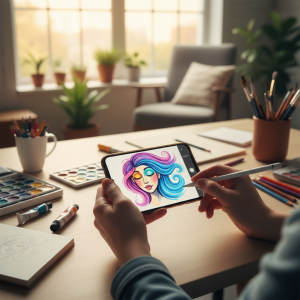
Let's start with the most important thing: These apps are for entertainment purposes and have no scientific basis.. None of them discover, calculate, or guess the face of a real person. What they do is assemble a... simulation — a fictional portrait created by artificial intelligence based on the characteristics you provide. Knowing this, the game is great; without knowing this, disappointment is certain (and sometimes you'll be charged for a subscription you don't intend to make.
This guide is practical. Instead of listing promises, it shows you step-by-step how to create this simulation yourself using real apps available on Google Play and the App Store, how much it costs, what to do with your photos, and how to avoid common pitfalls in this category. In the end, you'll have a fun portrait to show your friends—and a clear understanding of its meaning.
Simulation vs. prediction: understand the difference
Prediction is when a system uses past data to estimate something in the future—like a traffic app calculating arrival time. Simulation is when a system designs a possibility based on rules and a description. "Soulmate face" apps do the latter.
In practice, you answer a questionnaire or send a selfie, and the image model returns a face that never existed, assembled from visual patterns learned from photo banks. If you change a single answer, the face changes. If you repeat exactly the same answers, the face also changes, because there is a random factor embedded in the generation. None of these behaviors match prediction—they all match custom design.
That doesn't take away the fun. It just removes the wrong expectation. It's the same difference between a composite sketch done by an illustrator and a photograph: both are images, but only one of them records someone who exists.
It's also worth clearing up a common misconception. Some texts out there suggest that the app "cross-references your face with a database of millions of people" to find someone who matches you. This doesn't happen—and, if it did, it would be a serious privacy issue because it would mean using the image of real people without authorization. What image banks do is serve as training material for models to learn how to draw faces in general, not to identify individuals.
Step-by-step guide to creating your simulation.
You don't need a specific "soulmate" app to do this — in fact, the result is usually better with established image editors and generators. The script is as follows:
- Write the description. Before opening any application, put together a sentence including age range, hair type, face shape, clothing style, and the mood of the photo (natural light, simple background). The more specific the description, the better the portrait.
- Choose the tool. To create a portrait from scratch, use a text-based image generator. To start with an existing photo of yourself, use a face editor.
- Generate multiple versions. Request three or four variations of the same description and compare them. This makes it clear that the app is creating, not revealing.
- Adjust and save. Refine one detail at a time (just the hair, just the lighting) until you achieve a result you like. Save it to your gallery.
- Clean up the tracks. If you do not intend to continue using it, delete the uploaded images within the app and cancel any free trial you may have started.
Here's a tip that makes a difference in the result: describe the lighting and framing, not just the face. Terms like "profile picture, neutral background, soft window light" usually generate much more convincing portraits than a loose list of features. And avoid asking for "the most beautiful person in the world" or things like that — vague descriptions produce generic faces, with that artificial look that gives away the image's origin.
Real-life apps for this simulation.
All the apps below are published in official app stores and deliver exactly what they advertise. Always install from your phone's app store: APK files from websites, group links, or "modified versions" pose a security risk with no added benefit.
1. Picsart — retrato criado a partir de texto
O Picsart It's the most versatile on the list. Besides being a full-featured editor, it has image generation based on written descriptions, which is exactly the feature needed here. You type the description from step 1, choose a style (photo, illustration, painting), and receive the variations.
The free version has a limit on the number of generations per day and watermarks some features; the subscription unlocks the rest. For playing around, the free plan is usually sufficient.
2. Google Gemini — a opção mais transparente
O Google Gemini It allows you to request the image by talking: "create a portrait of a person around 30 years old, curly hair, a discreet smile, late afternoon light." He returns the illustration and even explains what he did. It's the most honest way to do this simulation, because it makes it clear the whole time that it's a creation.
3. Lensa — retratos estilizados a partir de selfies
O Lens It works with a batch of your photos and returns stylized portraits. It's good for those who want to see "how" a visual pair matching their style would look. Warning: because it uses many selfies, this app requires the most care with privacy — read the policy beforehand and delete the package afterward.
4. FaceApp — transformar em vez de criar
O FaceApp It changes the apparent age, hairstyle, beard, and expression in an existing photo. It's the right choice when you want to start with a real face (yours or someone else's with permission) and explore variations, rather than inventing a face from scratch.
It has a free trial that automatically converts to a subscription. If you decide to try it, mark the cancellation date on your calendar.
5. Reface — a versão descontraída
O Reface Swap faces in photos and short videos. It's the lightest on the list and the least serious—perfect for turning a joke into a funny video to send to a group, without any risk of confusion about what's real.
6. YouCam Perfect — para quem quer rapidez
O YouCam Perfect It combines retouching, virtual makeup, and AI-generated portraits in a very simple interface. It's the option for those who don't want to learn any tools and just want a beautiful result in two taps.

How much does it cost and how can I avoid being charged unintentionally?
Almost all apps in this category follow the same model: a limited free trial and a weekly, monthly, or annual subscription. The problem isn't the price itself, it's the free trial that renews automatically. Three measures solve this:
- Read the price on the store's information sheet., In the in-app purchases section, before installing.
- Cancel immediately after signing up for the trial. On Google Play and the App Store, access continues until the end of the period even if the cancellation was made on the first day.
- Review your subscriptions once a month. in the store settings. It's common to find charges for apps you've only used once.
Privacy: What happens to your photo?
Facial images are sensitive personal data. When you send a selfie to an AI app, it typically leaves your phone and is processed on a server. This isn't necessarily a bad thing—it's how most of these tools work—but it does require some caution.
- Use photos that you wouldn't mind seeing elsewhere.
- Do not send photos of other people, especially children, without permission.
- Check the privacy policy to see how long the images are stored and if there is an option to delete them.
- Grant only the necessary permissions. An image generator doesn't need contacts, a calendar, or a location.
- When uninstalling, also delete the account within the app, if it offers that option.
Other games from the same universe
Those who enjoy simulating the face of their soulmate usually also enjoy compatibility tests and astrological charts. The same rule applies here: they are entertainment, without scientific basis, and should be read like reading a newspaper horoscope. Two real and well-made apps in this vein:
- Co-StarIt creates an astrological chart with your date, time, and place of birth and allows you to compare your profile with those of friends who also use the app.
- The PatternIt focuses on descriptions of personality and life stages, with a more introspective text and less emphasis on prediction.
If this topic interests you, we have a similar guide about it. past life apps, and another with the complete list of Discover what your soulmate looks like: what the apps really do., explaining how each technology works internally.
Signs that an app is overdoing it.
Some apps in this category use language that promises the impossible. If you encounter any of these signs, be suspicious:
- It mentions "precision," "reliable results," or "proven" methods for divination.
- He only shows his face after payment — he charges for the curiosity, not for the service.
- It claims to "cross-reference" your face with a database of real people to find your match. This, besides being improbable, would be a serious privacy issue.
- It requires installation outside of the official store or submission of documentation.
Do you prefer to meet real people?
If curiosity stems from a genuine desire to find someone, dating apps are a better solution. They don't guess anything, but they greatly expand the circle of people you can talk to. The most used in Brazil are... Tinder, O Bumble, O happn and the Badoo. Our full comparison is available at best dating apps.
Two rules that apply to any of them: arrange the first meetings in a public place and never send money to someone you met online, no matter how convincing the story may seem.
Common questions
O rosto que o app gerou é de alguém real?
No. It's an image created by the model, combining visual patterns. It doesn't correspond to any specific person.
Preciso enviar foto para usar esses aplicativos?
It depends. Text-based generators, like Picsart and Gemini, only work with written descriptions. Facial editors, like FaceApp and Lensa, require an image.
Existe versão para iPhone?
Yes, all the apps mentioned are also available on the App Store. Search for the exact name within the iPhone's app store to find their official listings.
Dá para usar sem pagar nada?
Yes, it's possible, but with limitations. Everyone has enough free layers to generate some portraits. What changes in the paid version is the quantity, the resolution, and the absence of a watermark.
Conclusion
Simulating what your soulmate's face might look like is a fun game and, with the right tools, it's also free. Just remember what's happening underneath: an image model is drawing a face from your description, with no ability to predict who will appear in your life.
Install from official app stores, manage permissions and subscriptions, save the cool portrait, and take the result for what it is: an image created for fun. The real connection still happens the same way as always—talking to people.