
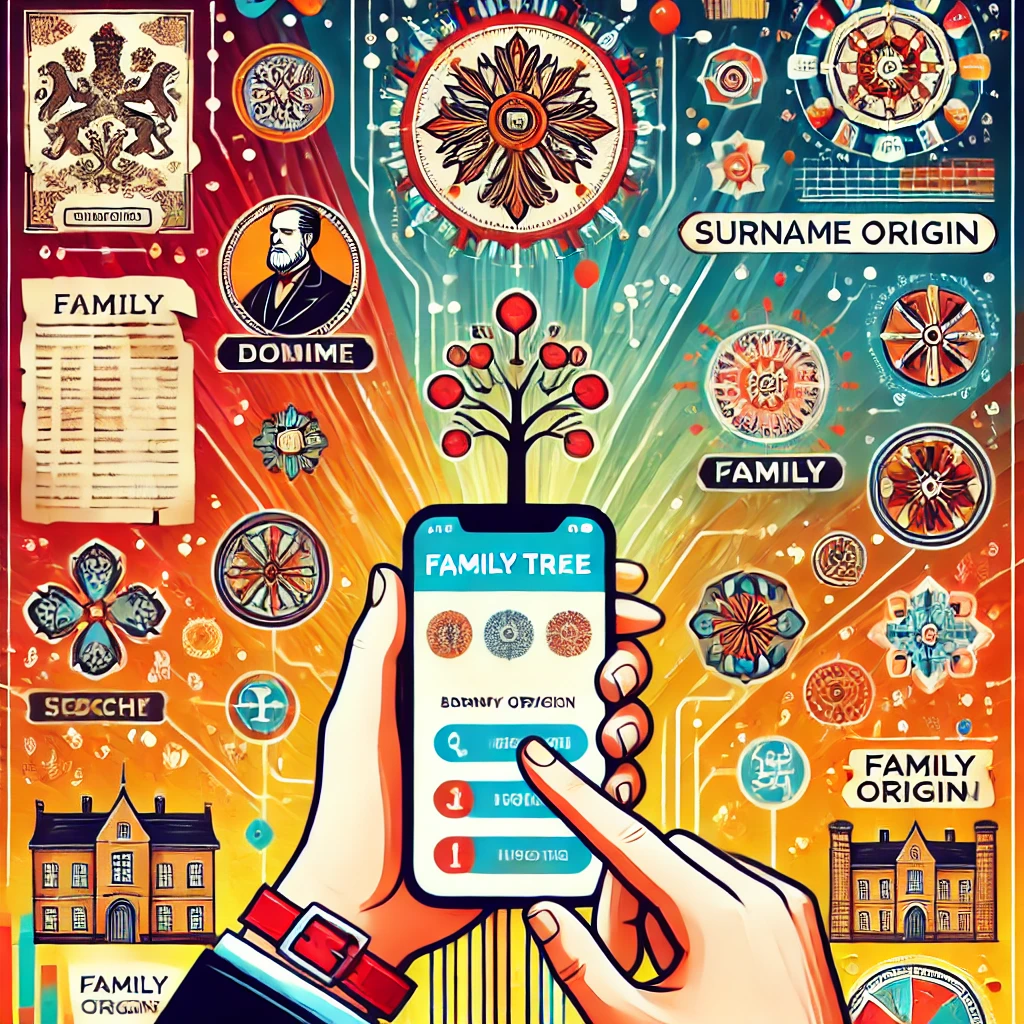
Discovering the origin of your surname can be a fascinating and revealing experience. Your family history is often intrinsically linked to your surname, and with current technology, it's possible to uncover these secrets practically and efficiently. Using specific apps, you can consult records and clues about your ancestry directly from your cell phone. It's worth adjusting your expectations: what these apps deliver is the origin. likely the surname — the region where it appears most often, the meaning that researchers attribute to it — and digitized historical records that they can Being from your family. None of this is a certificate or proof of kinship: people with the same surname often have no relation whatsoever, and the same name may have originated in different places. To confirm your actual lineage, the way to go is to look for certificates in registry offices, parish books, public archives, and immigration records.
Furthermore, curiosity about the origin of the surname is common among many people. Knowing more about your roots can provide a sense of identity and belonging. Therefore, exploring this possibility with genealogy apps is an interesting and accessible way to connect with the past.
Top Apps to Discover the Origin of Your Last Name
Currently, there are several applications available that allow you to perform a detailed and informative surname search. Below, we list five of the most popular and efficient genealogy apps that can be used directly on your cell phone.
1. Ancestry
Ancestry is one of the most popular apps when it comes to genealogy. With it, you can explore the origin of your surname and search through a huge database of historical records. An important point: coverage is very uneven by country. The collection is strong in the United States and the United Kingdom and much thinner in Brazil, so it's common to find your ancestors only up to the immigration ship — from there backward, the research goes through the archives of the country of origin.
On the other hand, Ancestry also allows the creation of digital family trees, making it easier to view and organize the information collected. With an intuitive interface, you can insert data, photos and documents, making your family tree a true timeline of your family history.
2. MyHeritage
Another application that stands out in the genealogy area is MyHeritage. This app is known for its advanced online surname analysis functionalities, allowing thorough research into your family origins. Additionally, MyHeritage has a large community of users, enabling connections with distant relatives and sharing of information.
In addition, MyHeritage offers DNA tools that can complement surname research with genetic data. Here too, caution is advised: the tests return a... I estimated percentages by region, calculated using comparison databases. The numbers often differ between companies and are revised as the database grows — they serve to indicate trends, not to pinpoint which city your great-grandfather came from.
3. FamilySearch
FamilySearch is an excellent option for anyone who wants to discover their family history for free. This family history app is maintained by a non-profit organization, which guarantees access to a vast amount of historical records at no cost. With it, you can research the origin of your surname and build your digital family tree.
Furthermore, FamilySearch allows collaboration between family members, facilitating the sharing of information and the joint construction of family history. This functionality makes research more dynamic and rich, as different family members contribute their knowledge and discoveries.
4. Geneanet
Geneanet is an application focused on collaborative genealogical research. With a community approach, it allows users from all over the world to contribute their discoveries, enriching the available database. This facilitates online surname analysis by offering a wide range of historical records and documents.
Furthermore, Geneanet has specific tools for creating and maintaining digital family trees. The interface is friendly and intuitive, allowing you to organize your discoveries in a practical and efficient way. This allows you to visualize the evolution of your family history over time.
5. Findmypast
Finally, Findmypast is another app that deserves mention. Focused on researching historical records, it offers a vast collection of documents that can help you discover the origin of your surname. With a modern interface and advanced features, Findmypast facilitates the search for documents, with its collection concentrated mainly in the United Kingdom and Ireland.
Furthermore, Findmypast allows integration with other genealogy services, such as Ancestry and MyHeritage, further expanding research possibilities. This way, you can use multiple sources to build a rich, well-documented family history.
Functionalities of Genealogy Applications
Genealogy apps offer a series of features that make surname research and family history construction more accessible and practical. Firstly, they allow you to create digital family trees, where you can enter and organize information about your ancestors. Furthermore, many of these applications have extensive databases with historical records, such as birth, marriage and death certificates.
Another important feature is online surname analysis, where the app cross-references spellings and the distribution of the name in records to suggest the most likely origin. It's a statistical analysis, not a definitive verdict: very common names appear in several regions at the same time, and spellings have changed significantly over time and across languages. Some apps also offer DNA tools, allowing you to supplement historical research with genetic data.
Conclusion
Discovering clues about the origin of your surname and your family history has never been easier. With the help of specialized apps like Ancestry, MyHeritage, FamilySearch, Geneanet, and Findmypast, you can conduct detailed and informative research directly from your mobile phone. Furthermore, the functionalities offered by... these apps, Tools like creating digital family trees and online surname analysis make the process even more interesting and accessible.
Therefore, exploring your roots can be an enriching experience. Use the apps as a starting point and treat each finding as a hypothesis: when you find an ancestor who seems to be yours, confirm it with a birth certificate from the registry office or parish record before taking the relationship as certain. It is this verification that transforms a good suspicion into a documented family history.
Criteria that make a difference in the choice
- The certificate has an expiration date. Application certificates are rarely formally recognized. If the goal is a resume, confirm this beforehand.
- What is free. Many offer the first few lessons for free and charge for continuing. It's worth seeing how far the free portion goes.
- Pace and time per session. Short daily sessions work better than weekly marathons, and some apps are designed for that purpose.
- It works offline. Studying while commuting requires downloading lessons beforehand, and not all apps allow this.
What these apps don't do
It's important to know what's beyond the reach of this category—that's what avoids frustration and, most importantly, prevents falling for those who promise the impossible.
- They are not a substitute for formal courses when a recognized certification is required.
- Gamification helps with consistency, but obscuring the content with points and sequences can give the feeling of greater progress than there actually is.
- Free content often covers the basics and stops right where the difficulty begins.
- Fluency is not guaranteed on its own: conversational practice with another person remains necessary.
Common questions
How much time per day?
15 to 20 minutes a day usually yields more results than two hours once a week, because spaced repetition is what makes it stick.
Is it possible to learn solely through the app?
You can go a long way in terms of vocabulary and comprehension. But to speak naturally, practice with another person remains irreplaceable.
Is it suitable for children?
Many have a kids' mode. It's worth checking the rating and whether there's advertising within the app.
Is the premium version worth paying for?
It makes sense when you've already established the habit and the free content has run out. Paying before establishing the routine usually results in a forgotten subscription.
Does it work offline?
Some allow you to download lessons. Check this, because that's what determines whether it's possible to study on public transport.